Open Access Peer-Reviewed Established 1988

Pakistan Journal of Pharmaceutical Sciences

Pakistan Journal of Pharmaceutical Sciences (PJPS) is an international, peer-reviewed, open-access journal dedicated to publishing high-quality research that advances pharmaceutical, biomedical, and medicinal sciences. Published by the Faculty of Pharmacy and Pharmaceutical Sciences, University of Karachi since 1988, PJPS provides a trusted platform for researchers, academicians, clinicians, and industry professionals worldwide to disseminate innovative discoveries, foster scientific collaboration, and accelerate the translation of research into better healthcare outcomes. We welcome original research, reviews, and emerging innovations that shape the future of pharmaceutical sciences.

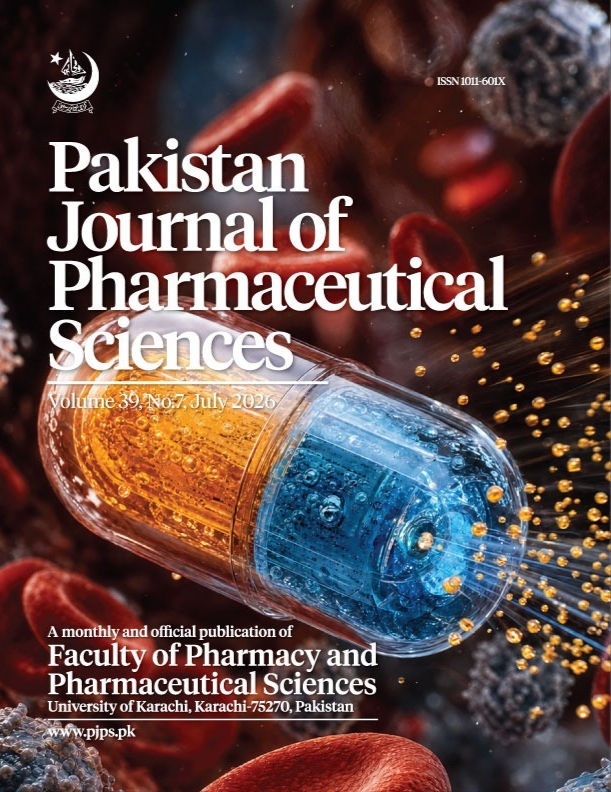
Journal Cover 39 Issue 11
0.6
IMPACT FACTOR
Clarivate Analytics
1011-601X/3105-9686
ISSN PRINT / ONLINE
Since 1988
12400+
TOTAL CITATIONS
Google Scholar
3500+
ARTICLES PUBLISHED
Peer-Reviewed
89+
COUNTRIES REACHED
Global Readership

Latest Research Articles

Browse All Articles
original articlesPublished: 01 Dec 2026
Volume 39, Issue 12

miRNA-34b overexpression alleviates neuromyelitis optica spectrum disorders by regulating the TIA-1-stress granule pathway

Abstract: Background: Neuromyelitis optica spectrum disorders (NMOSD) are autoimmune demyelinating diseases of the central nervous system. The role of microRNA-34b (miR-34b) in NMOSD pathogenesis remains unclear. This study investigates the expression and functional mechanism of miR-34b in NMOSD, specifically its regulation of the TIA-1-stress granule pathway. Objectives: To determine the expression level of miR-34b in NMOSD tissues and cell lines and to elucidate whether miR-34b suppresses cell proliferation and promotes apoptosis by directly targeting the TIA-1-stress granule pathway. Methods: Real-time PCR was used to detect miR-34b expression in 25 NMOSD tissue specimens obtained from a hospital laboratory (13 early-stage, 12 chronic-stage) and 10 normal control tissues, as well as in RGC-5 cells. RGC-5 cells were transfected with miR-34b mimics, inhibitors or negative controls. Cell proliferation was assessed by MTT assay and cell cycle distribution and apoptosis was analyzed by flow cytometry (PI staining and Annexin V-FITC/PI double staining, respectively). The direct binding between miR-34b and the 3'-UTR of TIA-1 mRNA was validated using a dual-luciferase reporter assay. Protein expression levels of TIA-1, SG, HuR, CDK2 and BCL-2 were measured by Western blot. A rescue experiment was performed by co-transfecting miR-34b mimics with a TIA-1 overexpression plasmid. Results: miR-34b was lower in NMOSD vs controls (0.32 ± 0.08 vs. 1.00 ± 0.12, P<0.01), especially in the chronic stage. miR-34b mimics inhibited proliferation, induced G0/G1 arrest (68.5% vs. 52.1%, P<0.01) and increased apoptosis (22.6% vs. 8.3%, P<0.001). miR-34b inhibitor had opposite effects. miR-34b directly bound TIA-1 3'-UTR and downregulated TIA-1, SG, HuR. TIA-1 overexpression partially reversed miR-34b effects. Conclusions: miR-34b is downregulated in NMOSD. Overexpression of miR-34b suppresses proliferation and promotes apoptosis by targeting the TIA-1-stress granule pathway. Restoring miR-34b may be a therapeutic strategy for NMOSD.

Page No:3744-3754
Yan Dai, Anlang Dai, Yuhuan Liu
View Abstract
original articlesPublished: 01 Dec 2026
Volume 39, Issue 12

Britanin improved high-fat diet-induced obesity by regulating the MAPK signaling pathway

Abstract: Background: The escalating prevalence of obesity has made it a critical public health concern. There is an urgent need to identify naturally derived compounds with anti-obesity potential. Britanin (BRI), a bioactive sesquiterpene lactone derived from Inula species, has shown promise in metabolic disorder management, but its anti-obesity mechanisms remain uncharacterized. Objectives: Combining animal experiments and network pharmacology analysis to explore the effect of BRI in high-fat diet-induced obesity. Methods: C57BL/6J male mice were used for experiment. A high-fat diet (HFD)-induced obese mouse model was treated with BRI (5/15 mg/kg, i.p.) to validate lipid metabolism and weight loss. Network pharmacology identified potential targets via SwissTargetPrediction, GeneCards and OMIM databases, with molecular docking (CB-DOCK) and PPI network analysis (STRING/Cytoscape). Relevant validations were conducted based on the screened targets. Additionally, a biosafety assessment was performed. Results: In-vivo, 15 mg/kg BRI reduced body weight by 18%, decreased serum TG (-45%, p<0.001), TC (-37%, p<0.001) and LDL-C (-32%, p<0.01) and reversed adipocyte hypertrophy. Thirty-nine intersection targets were identified, with MAPK1, EGFR, PTGS2, MAP2K1 and MAPK8 as top hubs (degree centrality >15). BRI exhibited strong binding affinity (-7.7 to -10.3 kcal/mol) to these targets. Mechanistically, BRI exerts its anti-obesity effects by regulating key targets within the MAPK signaling pathway, particularly MAPK1 and inhibited the PPARγ, thereby blocking adipogenesis and promoting the transition of adipose tissue. Conclusion: BRI may alleviate obesity by regulating the Mitogen-Activated Protein Kinase signaling pathway, providing a rationale for natural compound-based obesity therapy.

Page No:3729-3743
YiQing Zhang, ZhiKang Wu, Xian LiView more
View Abstract
original articlesPublished: 01 Dec 2026
Volume 39, Issue 12

Glycated hemoglobin and retinal microvascular changes in type 2 diabetic retinopathy patients treated with metformin and/or insulin: A retrospective study

Abstract: Background: Diabetes retinopathy (DR) is the main blinding complication of type 2 diabetes (T2DM). Glycated hemoglobin (HbA1c) can reflect long-term blood glucose control and optical coherence tomography (OCT) can evaluate retinal microvessels. The effects of metformin and insulin regimens on microvascular structure are not yet clear. Objectives: To explore the relationship between HbA1c levels and retinal microvascular changes in T2DM patients receiving metformin and/or insulin and to evaluate the impact of different hypoglycemic regimens on DR progression. Methods: This retrospective study included T2DM patients with non proliferative DR treated between January 2023 and December 2024. After propensity score matching (PSM), 31 patients per group received metformin monotherapy (M), insulin based therapy (Ins), or combined therapy (M Ins). HbA1c, HbA1c variability (HbA1c SD), DR grade, central macular thickness (CMT), retinal nerve fiber layer (RNFL) thickness and superficial/deep capillary plexus (SCP/DCP) density were recorded at baseline, 1 and 2 year follow up. Multiple linear regression and Cox regression were used. Results: After 2 years, HbA1c and HbA1c SD decreased significantly in all groups (p<0.05), with greater reduction in the M Ins group. DR progression was documented in 23 patients (24.7%), with rates of 16.1%, 38.7% and 19.4% in the M, Ins and M-Ins groups, respectively (p>0.05). OCT showed reduced CMT/RNFL and increased SCP/DCP density in all groups (p<0.05), with better improvement in M Ins group (p<0.05). HbA1c correlated positively with CMT/RNFL and negatively with SCP/DCP (p<0.05). Cox regression indicated that higher HbA1c-SD was an independent risk factor for DR progression (HR = 3.216, 95% CI: 1.011–10.230, p= 0.048), while metformin use was an independent protective factor (HR=0.694, 95% CI: 0.451–0.840, p=0.001). Conclusion: Metformin plus insulin was associated with greater HbA1c reduction, decreased glycemic variability and increased retinal vessel density and may thus slow DR progression. Both HbA1c-SD and SCP density were correlated with DR progression risk, supporting the combined use of glycemic variability and OCT parameters for clinical evaluation and treatment guidance.

Page No:3717-3728
Zhongshu Han, Ping Zhu
View Abstract
original articlesPublished: 01 Dec 2026
Volume 39, Issue 12

PBPK modeling of intravenous/oral acetaminophen in healthy and pregnant individuals

Abstract: Background: Drug metabolism may be influenced by pregnancy. Use of acetaminophen (APAP) is prevalent among pregnant women, necessitating the development of effective methods for predicting its in-vivo disposition. Objectives: A whole physiologically based pharmacokinetic model was developed to predict the pharmacokinetic behavior of APAP following oral or intravenous administration in both healthy subjects and pregnant women across different trimesters (first, second, and third trimesters). Methods: Phoenix WinNonlin 8.4 was used to establish the model, which was verified by literature data and the fold error method. Sensitivity analysis was used to identify the factors most sensitive to the model results. Results: The model was established successfully. The clearance rate and half-life of intravenous APAP increased during pregnancy and the changes were more obvious with the increase of pregnancy trimesters. Theoretically, adjusting the oral and intravenous doses for pregnant women in the third trimester to 1.23 and 1.16 times those administered to healthy individuals may yield a comparable area under the curve in healthy subjects. According to the sensitivity analysis results, the influencing factors were ranked from largest to smallest as follows: activity of sulfatase > activity of glucuronidase > the constant of the gastrointestinal transport rate > activity of CYP450. Conclusion: Pregnancy affects the metabolism of APAP and more attention should be paid to pregnant women in clinical medication.

Page No:3706-3716
Weimin Kong, Yiting Yang, Xinru GuanView more
View Abstract
original articlesPublished: 01 Dec 2026
Volume 39, Issue 12

Rapid analysis of the chemical composition of the Equiseti hiemalis herba based on UHPLC-Q-Exactive Orbitrap MS with parallel reaction monitoring

Abstract: Background: Equiseti hiemalis herba (EH) is traditionally used for heat-clearing, promoting diuresis, resolving phlegm, relieving cough, improving vision and reducing ocular opacity. Previous phytochemical studies on EH have mainly focused on flavonoids and organic acids, whereas a comprehensive characterization of its chemical constituents remains lacking. Objectives: This study aimed to establish a rapid and systematic analytical strategy for the comprehensive characterization of chemical constituents in EH. Methods: In this work, a UHPLC-Q-Exactive Orbitrap MS system was employed for compound identification, utilizing full MS scan with subsequent data-dependent MS2 acquisition or parallel reaction monitoring incorporating an inclusion ion list. Results: A total of 82 compounds were identified or tentatively characterized from EH, including 34 organic acids, 22 flavonoids, 10 terpenes, 3 nucleotides, 3 amino acids, 3 coumarins, 2 alkaloids and 5 other compounds. Among them, 71 compounds were reported in EH for the first time. Organic acids and flavonoids were the predominant constituents, while the identification of terpenes further revealed the chemical diversity of EH. Conclusion: The established analytical strategy provides an effective approach for the rapid characterization of chemical constituents in EH and offers a theoretical basis for further studies on its pharmacodynamic material basis and pharmacological mechanisms.

Page No:3694-3705
Qing Li, Pei Xiong, Min ZhangView more
View Abstract

Browse by Topic

Research Scope & Subjects

Editorial Leadership

View Former Editors-in-Chief

Prof. Dr. Harris Shoaib

Editor-in-Chief

Faculty of Pharmacy and Pharmaceutical Sciences, University of Karachi, Karachi, Pakistan.

Specializing in Pharmacognosy and Natural Products Research, with over three decades of contribution to global pharmaceutical sciences.

2020 — PRESENT

Indexed & Abstracted in Leading Databases