original articles
Amlodipine besylate and valsartan combined mucoadhesive buccal patch formulations: In-vitro release and ex-vivo permeation studies
Nosheen Anwar, Rahman Gul, Syed Umer Jan, Ghulam Razaque Shahwani, Asif Mahmood, Tehmina Rabbani, Ahmed Abdullah, Seemab Naz, Falsafa Jamal
Available Online Date: 12 Sept 2026
Abstract
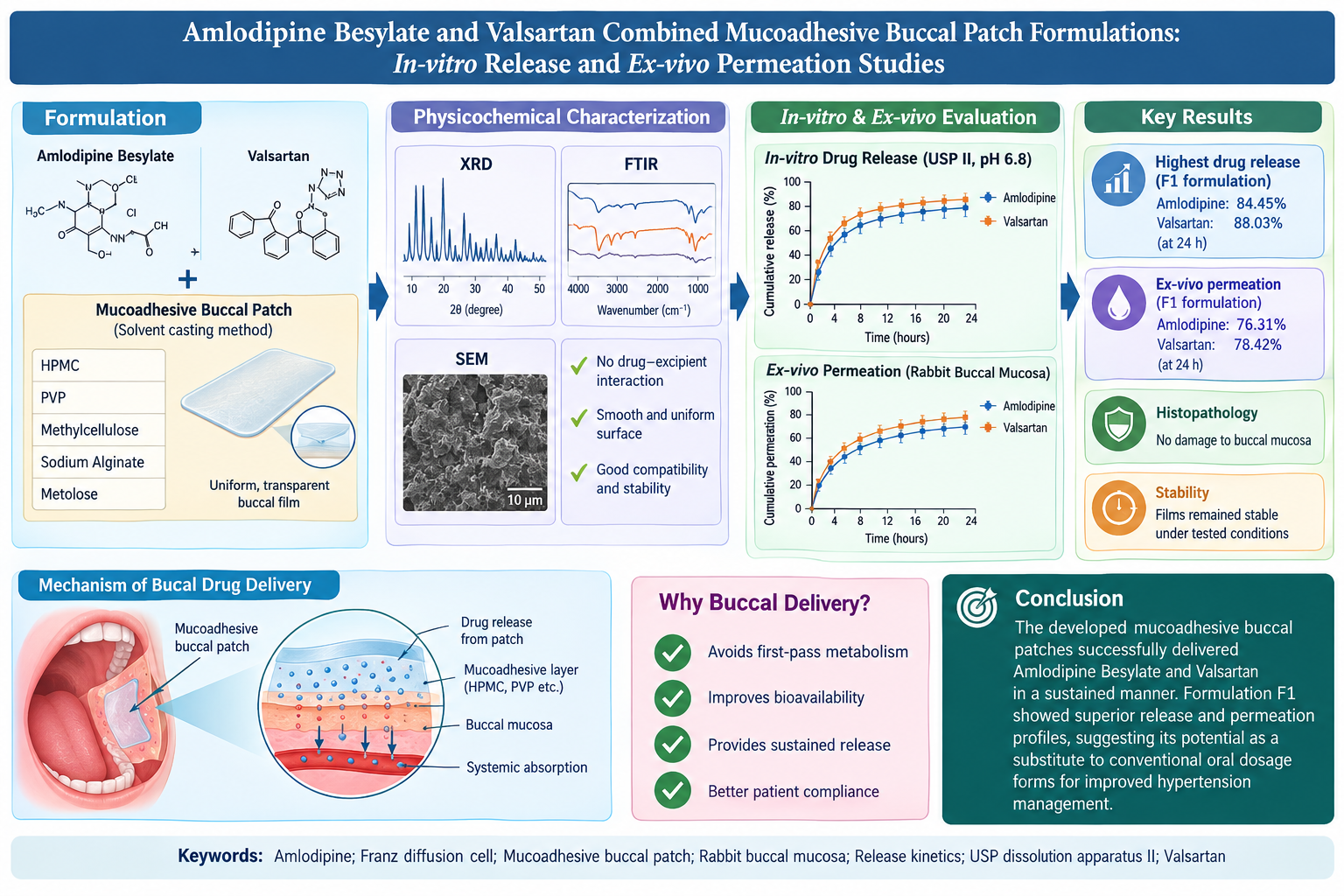
Abstract: Background: Oral fixed-dose combinations of Amlodipine Besylate and Valsartan are widely prescribed for hypertension but are associated with first-pass metabolism and variable bioavailability. Buccal drug delivery provides a favorable substitute to improve systemic availability and provide sustained release. Objectives: This study aimed to develop and assess mucoadhesive buccal patches containing Amlodipine Besylate and Valsartan to enhance bioavailability and achieve controlled drug release over 24 hours. Methods: Buccal patches were developed via the solvent-casting method using Hydroxypropyl Methylcellulose, Polyvinylpyrrolidone, Methylcellulose, Sodium Alginate and Metolose as backing membrane polymers. All the prepared films were evaluated for physicochemical parameters by means of X-ray Diffraction (XRD), Fourier transform infrared spectroscopy (FTIR), Scanning electron microscopy (SEM) and in vitro and ex vivo drug release. In-vitro drug release was studied with USP Apparatus II (paddle method) in 500 ml 6.8 pH phosphate buffer at 37 ± 0.5°C and 50 rpm for 24 hours. Ex vivo permeation studies were performed using a Franz diffusion cell fitted with rabbit buccal mucosa under similar conditions. Results: The formulations generally exhibited acceptable physicochemical characteristics within the evaluated parameters. The developed films appeared transparent with a uniform distribution of components. FTIR analysis did not indicate any detectable incompatibility or significant interaction between the drugs and excipients under the study conditions. Among all formulations, F1 contained the highest drug release and permeation. After 24 hours, cumulative release reached 84.45% for amlodipine and 88.03% for valsartan. Ex-vivo permeation was 76.31% and 78.42% for amlodipine and valsartan, respectively. Furthermore, buccal films' histopathological and stability studies were found to be harmless and functioned as an efficient dosage system. Conclusion: The developed mucoadhesive buccal patches successfully delivered both drugs in a sustained manner. Formulation F1 showed superior release and permeation profiles, suggesting its potential as substitute to conventional oral dosage forms for improved hypertension management.
Keywords
Amlodipine
Franz diffusion cell
Mucoadhesive buccal patch
Rabbit buccal mucosa
Release kinetics
USP dissolution apparatus II
Valsartan