original articles
Phenotypic biofilm formation and detection of biofilm-associated genes in multidrug-resistant Pseudomonas aeruginosa isolated from burn wounds
Muhammad Asif Zahoor, Abu Baker Siddique, Muhammad Shafique, Saima Muzammil, Nazia Abdulhaq, Rizwan Aslam, Zeeshan Nawaz
Available Online Date: 13 Sept 2026
Abstract
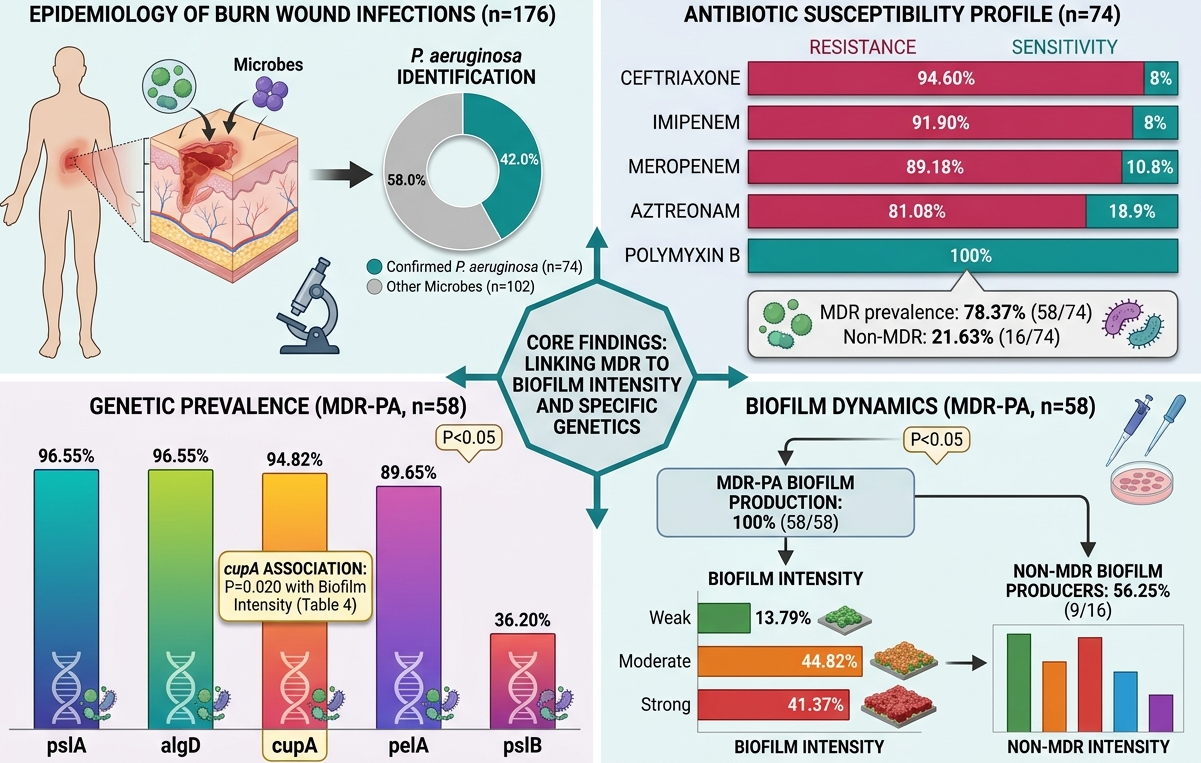
Abstract: Background: Pseudomonas aeruginosa is widely recognized as a ubiquitous, drug-resistant, biofilm-forming bacterium that produces numerous virulence factors and plays a prominent role in hospital-acquired infections. Objectives: This study aimed to determine the prevalence of multidrug resistance (MDR), biofilm formation and biofilm-associated genes among P. aeruginosa isolates recovered from burn wound infections. Methods: A prospective cross-sectional observational study was conducted in which total of 176 burn wound samples were collected and processed for bacterial isolation. Identification of isolates was confirmed by polymerase chain reaction (PCR) targeting the oprL gene. Antimicrobial susceptibility testing was performed using the Kirby–Bauer disc diffusion method. Biofilm-forming ability was assessed using the microtiter plate assay. Furthermore, PCR was used to detect biofilm-associated genes, including pelA, pelD, cupA, algD, pelF, pslA, pslB and pslD, in biofilm-producing isolates. Results: Out of 176 burn wound samples, 74 (42%) were positive for P. aeruginosa, among which 58 isolates were identified as MDR while all isolates remained susceptible to polymyxin B. Biofilm formation was observed in all MDR isolates, with 13.79%, 44.82% and 41.37% categorized as weak, moderate and strong biofilm producers, respectively, whereas only a limited proportion of non-MDR isolates demonstrated biofilm-forming ability (P = 0.001). Among MDR biofilm-forming isolates, biofilm-associated genes such as pslA and algD were each detected in 96.55% of isolates while cupA were identified in 94.82% of isolates. Notably, cupA showed a statistically significant association with biofilm-forming intensity (P = 0.020), suggesting its potential role in enhanced biofilm establishment among MDR isolates. Conclusion: Overall, the high prevalence of multidrug-resistant, biofilm-forming P. aeruginosa isolates recovered from burn wounds is an important microbiological concern. The frequent coexistence of multidrug resistance and biofilm-forming capacity observed in this study suggests a possible association that may complicate infection management and emphasizes the importance of continuous surveillance and effective infection control strategies.
Keywords
Burns
Biofilms
Multidrug resistant
Pseudomonas aeruginosa
Wound Infection