original articles
Xing Su San and Sang Xing Tang attenuate PM2.5-induced lung injury and inflammatory marker expression in rats
Meijing Kou, Youqiong Xie, Ruixue Jiang
Available Online Date: 15 Sept 2026
Abstract
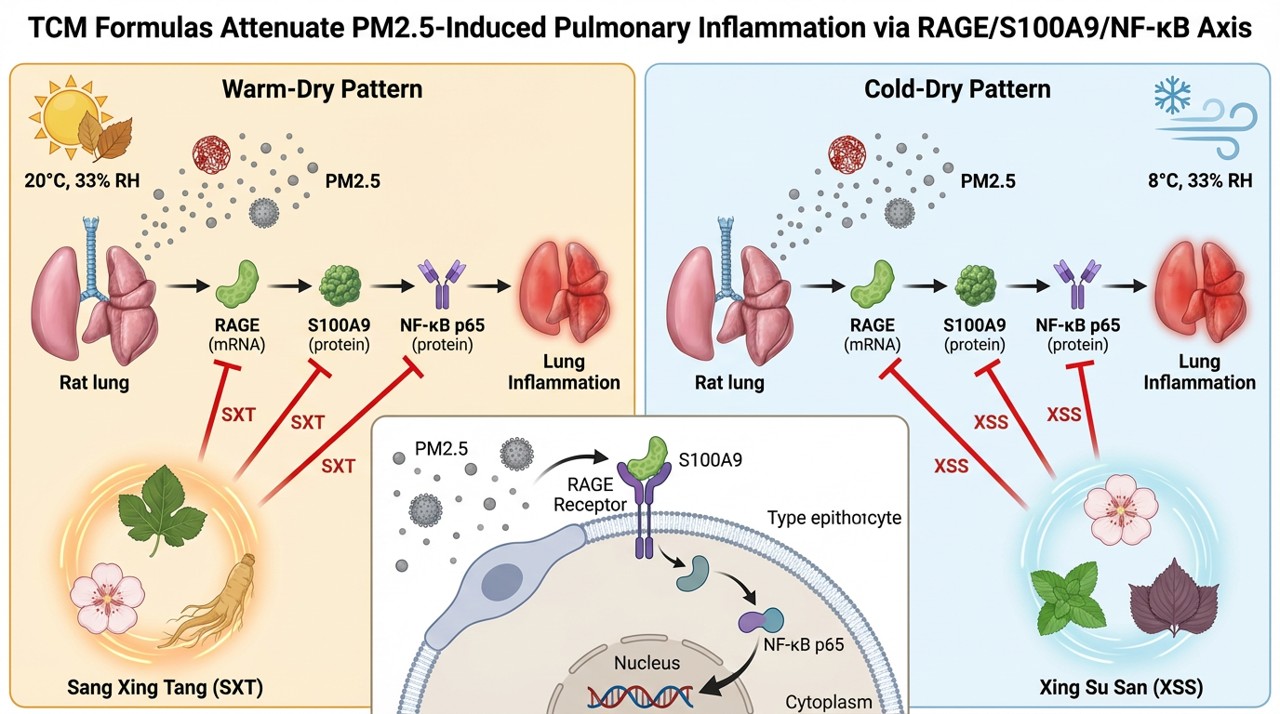
Abstract: Background: Fine particulate matter (PM2.5) induces lung inflammation through pathways involving receptor for advanced glycation end-products (RAGE), S100A9 and nuclear factor-kappa B (NF-κB). Xing Su San and Sang Xing Tang are traditional Chinese medicine formulas used for respiratory disorders associated with cool-dry and warm-dry conditions, respectively. Objectives: To investigate whether treatment with these formulas is associated with reduced expression of RAGE, S100A9 and NF-κB in lung tissue of rats exposed to PM2.5 under simulated warm-dry and cool-dry conditions. Methods: Forty male Wistar rats were divided into five groups (n=8 each): blank control, warm-dry model, cool-dry model, Sang Xing Tang treatment and Xing Su San treatment. Exposed groups received PM2.5 (500 µg/m³, 3 hours/day, 28 days) under warm-dry (20°C, 33% humidity) or cool-dry (8°C, 33% humidity) conditions. Treatment groups received oral gavage of Sang Xing Tang (8.5 g/kg) or Xing Su San (12.5 g/kg) before exposure. RAGE messenger RNA was measured by reverse transcription quantitative polymerase chain reaction, NF-κB p65 protein by Western blot and S100A9 by immunohistochemistry. Results: Both PM2.5 exposure conditions were associated with significantly increased RAGE (2.8-fold and 2.5-fold), NF-κB p65 (2.4-fold and 2.2-fold) and S100A9-positive cells (3.45% and 3.13%) compared to controls (0.82%; all P < 0.05). Sang Xing Tang treatment was associated with reduced markers in the warm-dry model (RAGE: 1.6-fold; NF-κB: 1.5-fold; S100A9: 2.25%). Xing Su San treatment was associated with reduced markers in the cool-dry model (RAGE: 1.5-fold; NF-κB: 1.4-fold; S100A9: 2.08%; all P < 0.05). Conclusion: Xing Su San and Sang Xing Tang attenuate PM2.5-induced upregulation of RAGE, S100A9 and NF-κB in rat lung tissue in a pattern-specific manner. These hypothesis-generating findings provide preliminary evidence warranting further mechanistic validation.
Keywords
Xing Su San
Sang Xing Tang
PM2.5
Lung injury
RAGE
S100A9
NF-κB
Traditional Chinese Medicine