original articles
The changes of hemodynamics and the effect of RHO kinase regulated by butylphthalein on apoptosis in acute myocardial infarction
Xi Feng, Xiurong Wang, Yonghua Zhang, Huaming Zhang
Vol. 40
Issue 1
Pages 140-149
Online Date: 15 Sept 2026
Published: 01 Jan 2027
Abstract
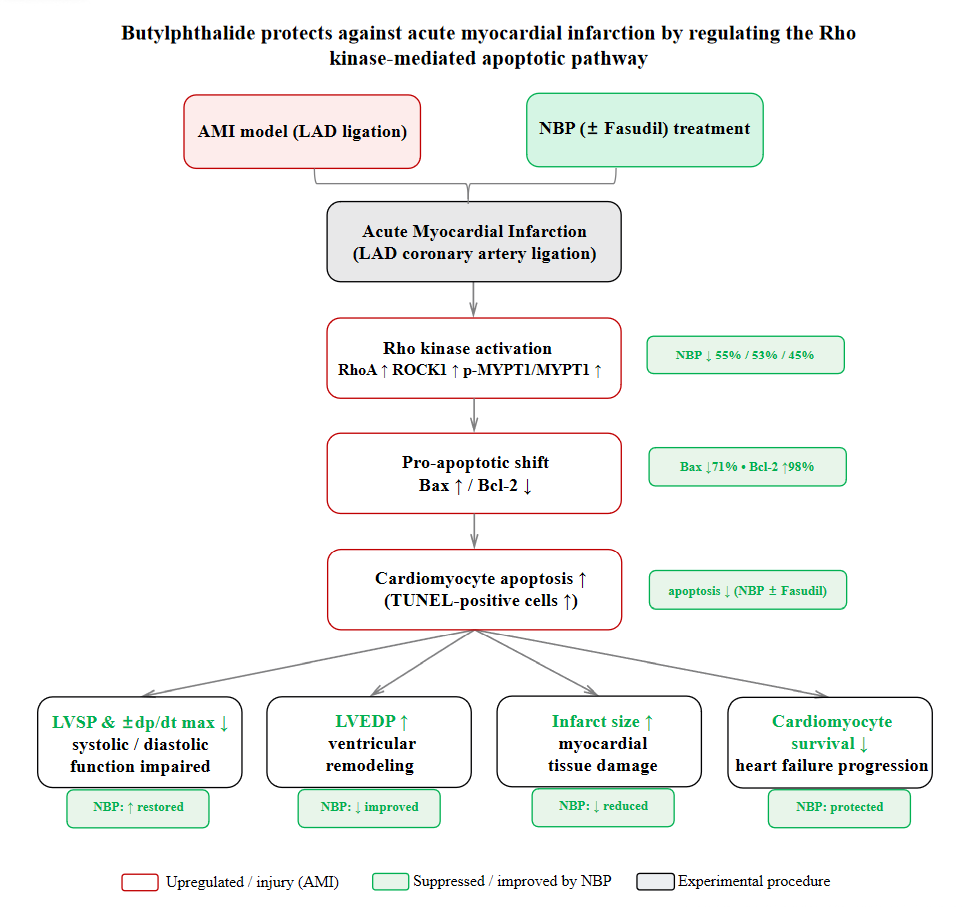
Abstract: Background: Cardiomyocyte apoptosis plays a critical role in ventricular remodeling and heart failure following acute myocardial infarction (AMI). The Rho kinase signaling pathway is known to be involved in this pathological process. Butylphthalein, a compound with neuroprotective effects, may exert cardioprotective effects by regulating this pathway. Objective: This study aims to investigate the effects of butylphthalein on hemodynamic parameters and cardiomyocyte apoptosis in a rat model of AMI and to explore whether these effects are mediated through the Rho kinase signaling pathway. Methods: Fifty SD rats were randomly divided into five groups: Sham, AMI model, butylphthalein, fasudil (a Rho kinase inhibitor) and combination therapy. AMI was induced by ligation of the left anterior descending coronary artery. Two weeks post-surgery, hemodynamic parameters—including left ventricular systolic pressure (LVSP), left ventricular end-diastolic pressure (LVEDP) and maximal rate of rise and fall of ventricular pressure (±dp/dtmax)—were measured. Cardiomyocyte apoptosis was assessed using TUNEL staining. The expression levels of Bcl-2, Bax, RhoA, ROCK1 and the p-MYPT1/MYPT1 ratio were detected by Western blot. Results: Rats in the AMI model group exhibited significant hemodynamic impairment and increased cardiomyocyte apoptosis. Compared with the model group, butylphthalein treatment significantly improved LVSP and ±dp/dtmax, reduced LVEDP, decreased the number of TUNEL-positive cells, upregulated Bcl-2 expression, downregulated Bax expression and suppressed the expression of RhoA/ROCK1 and the p-MYPT1/MYPT1 ratio (all P<0.05). The combination of butylphthalein and fasudil resulted in enhanced therapeutic effects, suggesting a synergistic inhibition of Rho kinase activity. Conclusion: Butylphthalein attenuates cardiomyocyte apoptosis and improves cardiac function in rats with AMI, likely through inhibition of the Rho kinase signaling pathway. These findings support its potential as a therapeutic agent for AMI.All experiments were performed on male Sprague-Dawley rats (n=50).
Keywords
Acute myocardial infarction
Butylphthalein
Cell apoptosis
Hemodynamics
Rho kinase