original articles
Berberine improves diabetic foot ulcer healing after tibial transverse osteotomy by inhibiting the PDGF-B/PDGFRβ signaling pathway
Rudong Zhang, Huanzhe Jiang
Vol. 40
Issue 1
Pages 150-164
Online Date: 16 Sept 2026
Published: 01 Jan 2027
Abstract
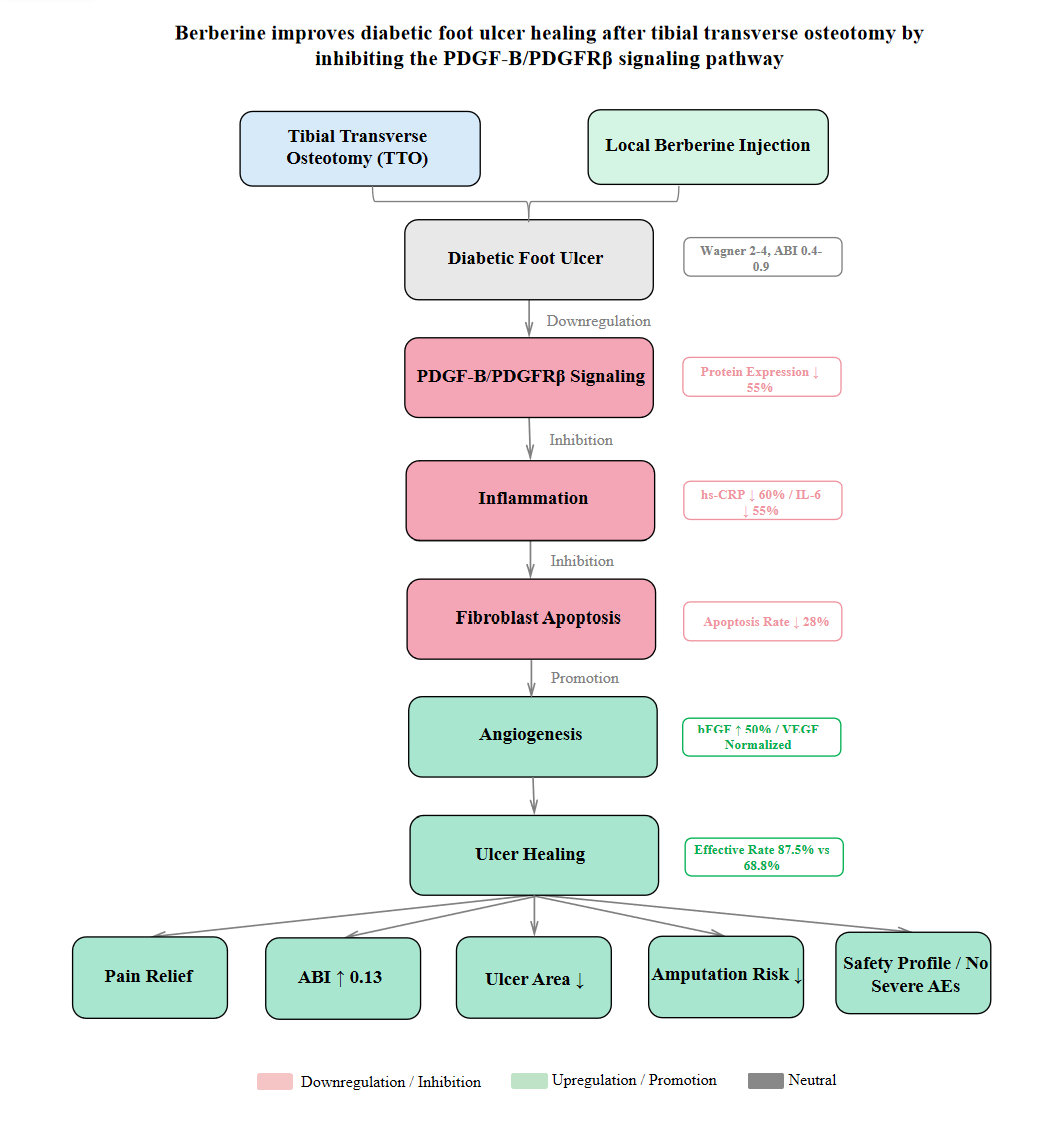
Abstract: Background: Tibial transverse osteotomy (TTO) is a promising but limited surgical option for diabetic foot (DF). Berberine, a natural compound from Coptis chinensis, exhibits anti-inflammatory and pro-angiogenic effects relevant to metabolic diseases. Objectives: This study aimed to evaluate whether adjunctive berberine enhances the therapeutic outcomes of TTO in DF patients and to explore its potential association with the platelet-derived growth factor-B (PDGF-B)/PDGF receptor-β (PDGFRβ) signaling pathway. Methods: This was a prospective, single-center, randomized, placebo-controlled, parallel-group, blinded trial. Of 200 screened DF patients, 96 eligible participants (Wagner grade 2–4) scheduled for TTO were randomized 1:1 to receive either TTO plus local berberine injections (n=48) or TTO plus local saline placebo (n=48). An additional non-randomized diabetic reference group (n=10) and healthy control group (n=10) were included for exploratory cellular studies only. The primary outcome was the total effective rate of ulcer healing at 3 months. Secondary outcomes included changes in Ankle-Brachial Index (ABI), ulcer area, Visual Analogue Scale (VAS) pain score and serum inflammatory markers (hs-CRP, IL-6). Exploratory outcomes comprised serum VEGF, bFGF and PDGF-B levels, as well as fibroblast apoptosis in wound tissue. Results: All 96 randomized participants completed the 3-month follow-up, with no dropouts. The berberine group demonstrated a significantly higher total effective rate than the surgery-alone group (87.5% vs. 68.8%; risk difference, 18.7%; 95% CI, 1.2% to 36.2%; P < 0.05). At 3 months, the berberine group also showed greater improvements in ABI (mean difference, 0.13; 95% CI, 0.08 to 0.18; P < 0.01) and ulcer healing rate (mean difference, 16.7%; 95% CI, 9.5% to 23.9%; P < 0.01), along with more significant reductions in hs-CRP and IL-6. Berberine treatment was associated with reduced fibroblast apoptosis in wound tissue (mean difference, -1.10%; 95% CI, -1.56% to -0.64%; P = 0.001) and lower protein expression of PDGF-B and PDGFRβ. No severe adverse events related to berberine injections were reported. Conclusion: In DF patients undergoing TTO, adjunctive local berberine therapy significantly improves the total effective rate and promotes ulcer healing, with benefits associated with reduced inflammation and fibroblast apoptosis and downregulation of the PDGF-B/PDGFRβ pathway. These findings are correlative and require further mechanistic validation. Larger multi-center trials are needed to confirm efficacy and safety.
Keywords
Berberine
Diabetic foot
PDGF-B/PDGFRβ
Tibial transverse osteotomy