original articles
Xinshuaifang improves oxidative stress injury
and myocardial remodeling in acute heart failure: Association with the
gut-heart axis
Kun Wang, Gaochao Wang
Available Online Date: 18 Sept 2026
Abstract
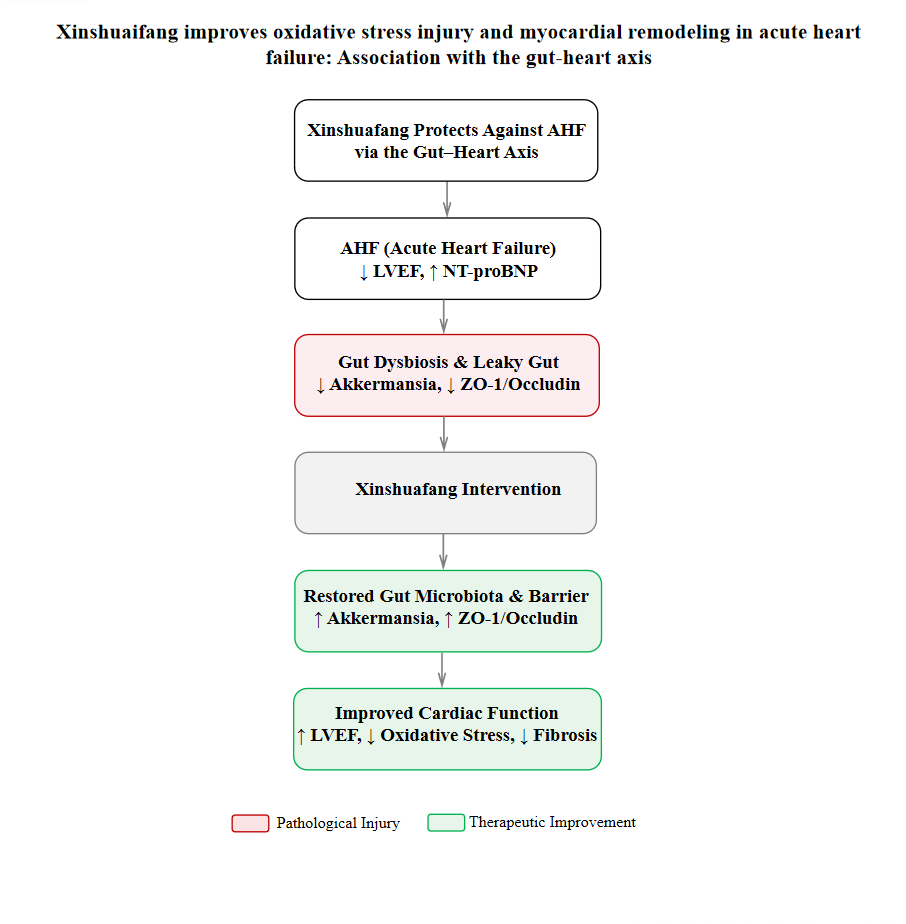
Abstract: Background: Acute heart failure (AHF) is a leading cause of death from cardiovascular disease and effective treatments are lacking. Objectives: To investigate whether Xinshuaifang improves oxidative stress injury and myocardial remodeling in AHF mice by regulating the gut-heart axis. Methods: C57BL/6 mice aged 8–10 weeks and weighing 20-25 g were randomized into 7 groups (n=8/group): control, AHF model, AHF+Xinshuaifang, AHF+control FMT, AHF+intervention FMT, AHF+Xinshuaifang+antibiotics and antibiotics-only control. AHF was induced by isoproterenol injection (5 mg/kg, 7 days). Gut microbiota composition, oxidative stress markers (MDA, GSH, SOD, MPO), cardiac function (LVDd, LVDs, LVEF, NT-proBNP), myocardial fibrosis and tight junction protein expression (ZO-1, Occludin, Claudin-1, Zonulin) were assessed. Results: Compared with controls, model mice showed significantly reduced Verrucomicrobia and Akkermansia abundance (P<0.01), increased MDA and GSH levels, decreased SOD activity and MPO levels, reduced LVEF, elevated NT-proBNP (P<0.01), decreased ZO-1, Occludin and Claudin-1 expression and increased Zonulin expression. Xinshuaifang intervention significantly reversed all these changes (P<0.01): it increased beneficial bacteria, reduced oxidative stress, improved cardiac function, upregulated ZO-1/Occludin/Claudin-1 and downregulated Zonulin. The FMT intervention group showed similar protective effects, whereas the Xinshuaifang+antibiotics group showed attenuated protection. Conclusion: Xinshuaifang improves cardiac function and alleviates oxidative stress and fibrosis in AHF mice by regulating gut microbiota, upregulating tight junction proteins and restoring intestinal barrier function.
Keywords
Acute heart failure
Gut-heart axis
Heart failure prescription
Myocardial remodeling
Oxidative stress