original articles
Evaluation of a four-herb Chinese medicine
formula at different concentrations on muscle damage and inflammation in a rat model of
DOMS
Yejun Zhan, Changmo Cho
Available Online Date: 21 Sept 2026
Abstract
Abstract: Background: Delayed onset muscle soreness (DOMS) impairs exercise recovery, while current
treatments remain limited. Traditional Chinese Medicine (TCM) formulas may
provide safe, multi-target interventions. Objectives:
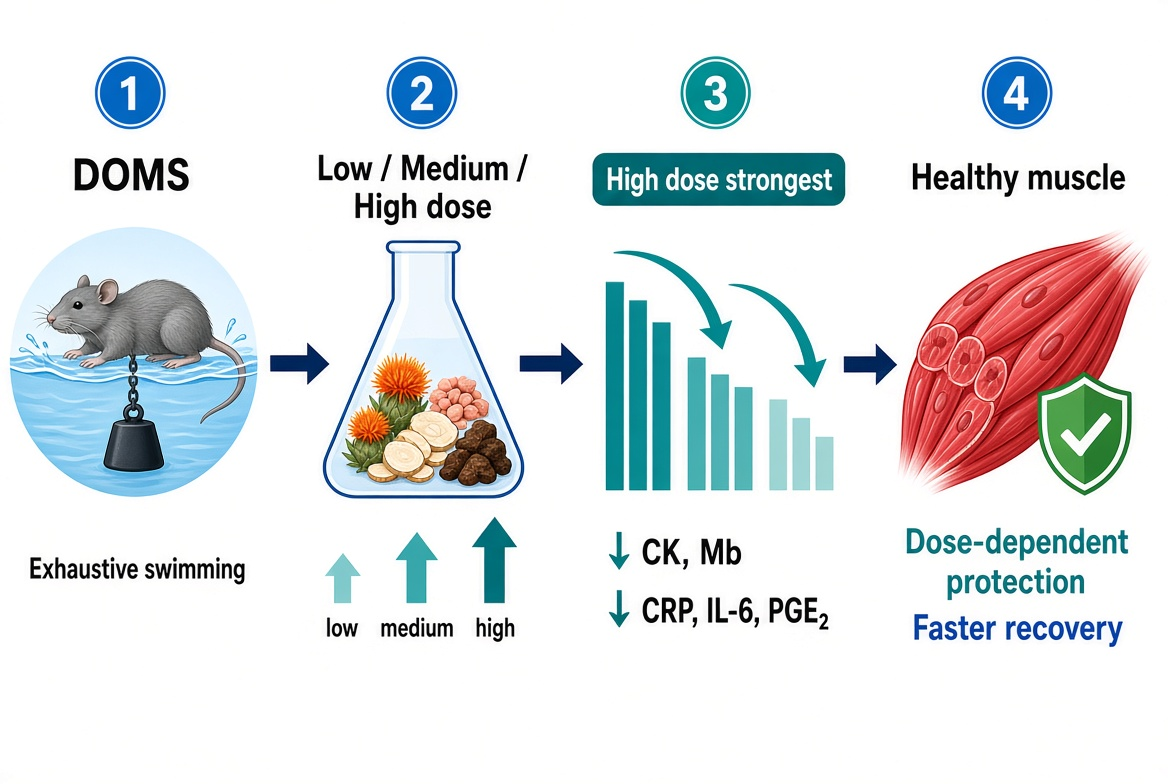
This study evaluated the dose-dependent protective effects of a four-herb
Chinese medicine formulation (safflower, Chinese Angelica, peach kernel and
myrrh) against DOMS in a rat model. Methods:
Thirty-two male SPF SD rats were randomly allocated to control or low- (1696
mg/kg), medium- (3392 mg/kg), or high-dose (6784 mg/kg) groups. The formulation
was administered orally for 11 days, with DOMS induced by exhaustive swimming
on day 8. Serum CK, Mb, CRP, IL-6, and PGE₂ were measured at baseline and at
24, 48, 72, and 96 h post-exercise. Results:
The medium- and high-dose groups exhibited significantly lower serum CK, Mb,
CRP, IL-6, and PGE₂ levels than controls, with the high-dose group showing the
largest reductions. The low-dose group showed limited or no significant
reductions in most markers, demonstrating a clear dose-dependent protective
effect. Conclusions: The formulation
dose-dependently attenuates muscle damage and inflammation in a rat DOMS model,
with high-dose treatment achieving the fastest recovery. Clinical trials are
warranted to confirm the efficacy
and safety in humans.
Keywords
Antioxidant
Anti-inflammatory
Chinese herbal medicine
Delayed onset muscle soreness (DOMS)
Dose–response relationship