original articles
Factors associated with
treatment response to laxative therapy in pediatric functional constipation: A
real-world retrospective study
Feng He, Li Liu, Liyuan Quan, Gaowei Ren
Available Online Date: 21 Sept 2026
Abstract
Abstract: Background:
Laxatives are the mainstay
for pediatric functional constipation (FC), yet response factors need more
real-world research. Objectives:
This study investigated factors associated with laxative treatment
response in children with functional constipation. Methods: Retrospective data were screened
from 103 pediatric FC patients receiving polyethylene glycol treatment (The
First Hospital of Qinhuangdao, Feb 2023–Nov 2025). After exclusion, 100 cases
were included and divided into the responder group (n=68) and the non-responder
group (n=32). The primary outcome measures included the Pediatric Constipation
Score (PCS), the Bristol Fecal Morphology Scale (BSFS) and defecation
frequency. Secondary endpoints included the incidence of abdominal pain,
incidence of bloating, average daily dietary fiber intake, average daily water
intake and average daily physical activity. A logistic regression analysis was
conducted to identify independent risk factors associated with treatment
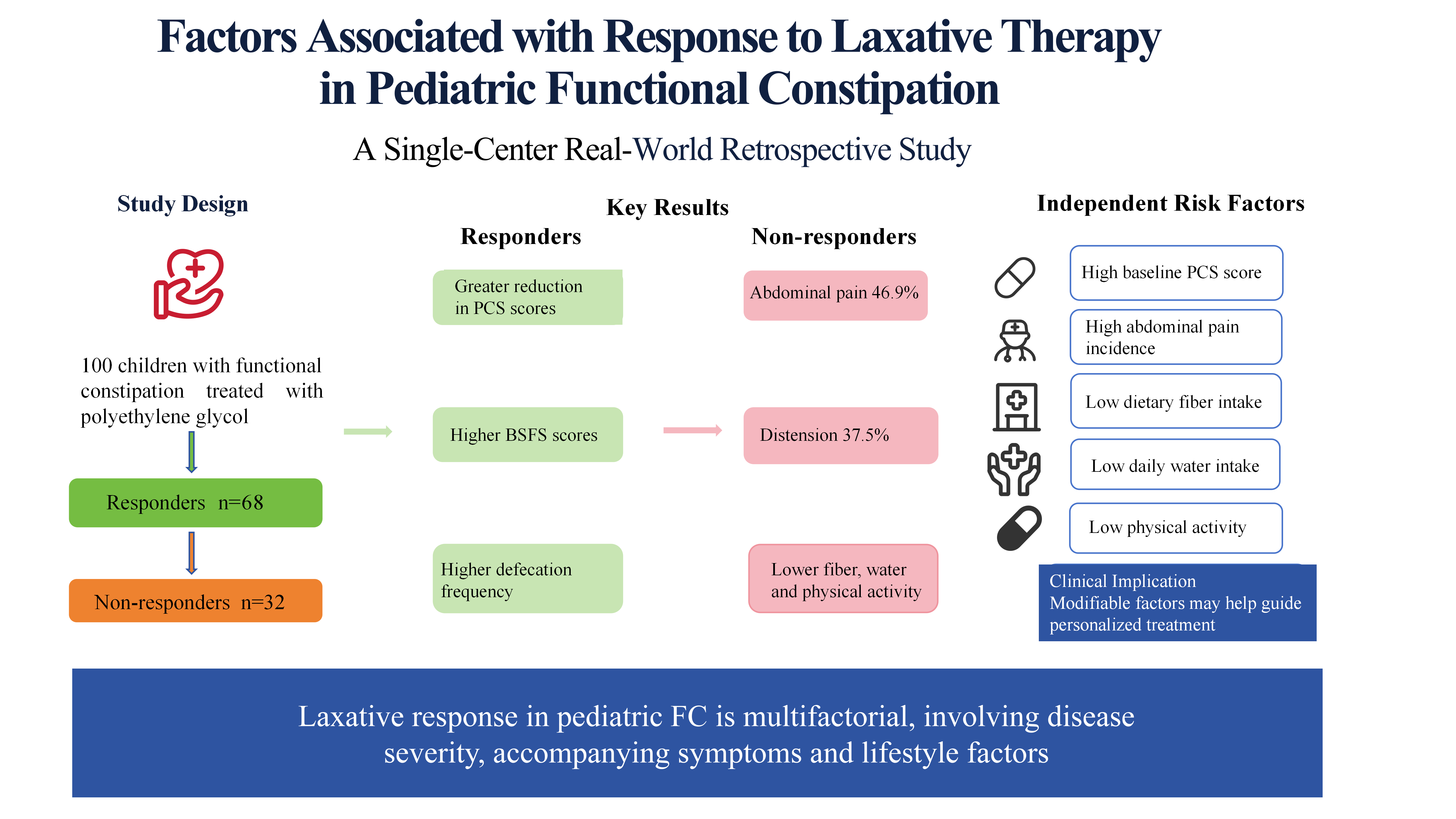
response. Results: The
baseline clinical characteristics of both groups were well-balanced (all P >
0.05). Post-treatment evaluation showed that the PCS score in the responder
group decreased more significantly compared to the non-responder group
(P<0.001). Meanwhile, increases in bowel movement frequency and BSFS scores
were more pronounced in the responder cohort (all P<0.001). Compared to the
non-responder group, the responder group also had lower incidences of abdominal
pain and distension (all P<0.05). In terms of lifestyle-related indicators,
the responder group had significantly higher daily average dietary fiber
intake, average daily water intake and average daily physical activity levels
(all P<0.001). Results from logistic regression analysis indicated that high
baseline PCS scores, elevated incidence of abdominal pain, insufficient dietary
fiber intake, low daily water intake and inadequate physical activity emerged
as independent risk factors for poor laxative response in pediatric FC patients
(all P<0.05). Conclusion: Laxative response in pediatric FC is affected by several
factors, such as severe constipation, poor diet, low activity and abdominal
pain.
Keywords
Influencing factors
Pediatric functional constipation
Polyethylene glycol
Treatment response