original articles
Protective effects of quercetin in experimental
ulcerative colitis: Potential involvement of ERK-MMP signaling
Qiliang Zhang, Min Guo, Yanrong Wang, Na Shen, Yongheng Wen, Zhiqian Zhou, Qiuzan Zhang
Available Online Date: 22 Sept 2026
Abstract
Abstract: Background:
Ulcerative colitis is a
relapsing inflammatory bowel disease driven by dysregulated immunity,
epithelial barrier injury and microbial imbalance. Current therapies remain
limited by relapse, adverse effects and incomplete response. Quercetin has
anti-inflammatory and barrier-protective activities and ERK-MMP signaling may
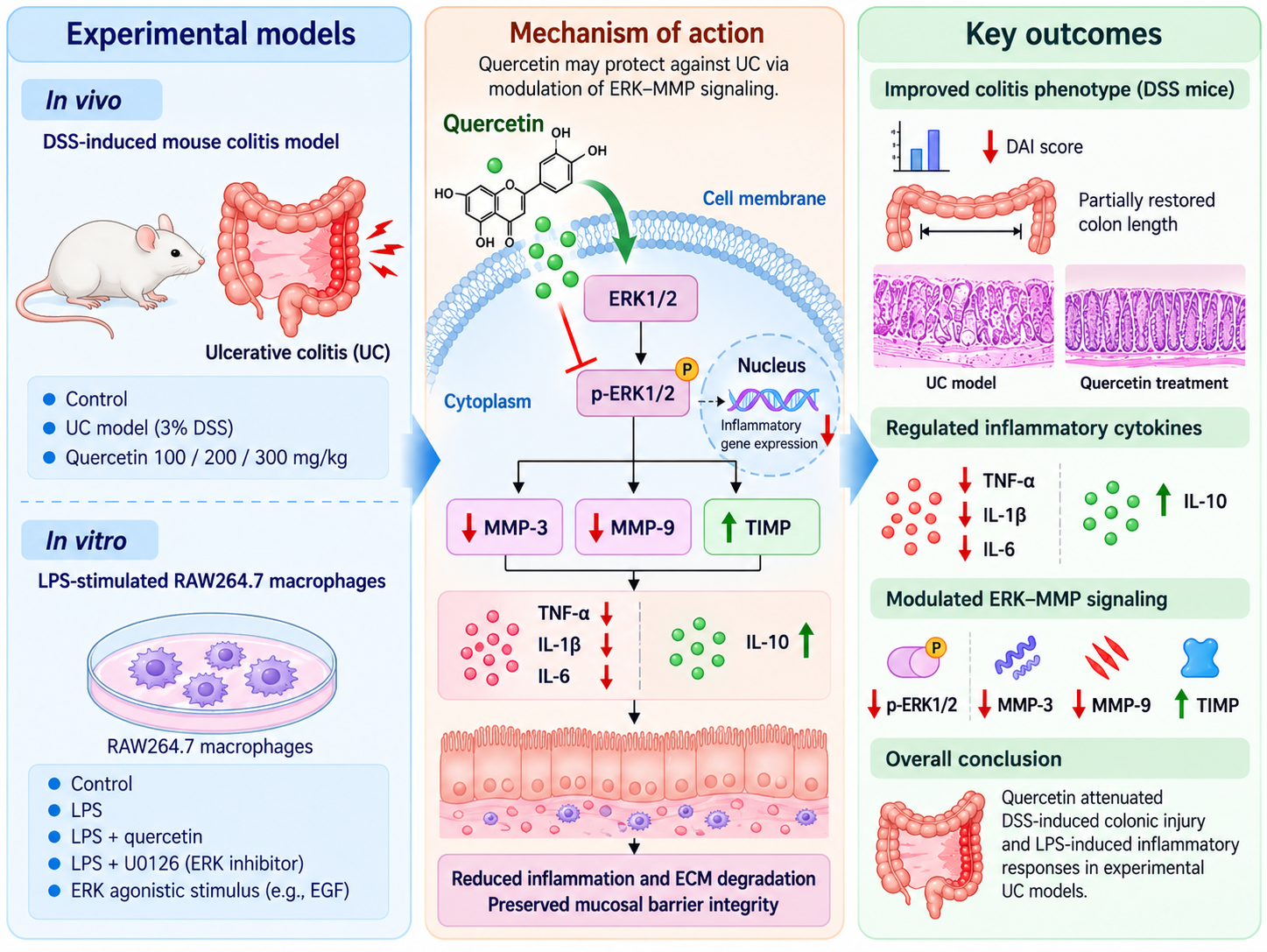
link inflammation to mucosal tissue damage. Objectives: To evaluate whether the protective effects of
quercetin in experimental ulcerative colitis (UC) are associated with
modulation of ERK-MMP signaling, while avoiding causal overinterpretation
beyond the animal and cellular evidence. Methods: A dextran sulfate
sodium (DSS)-induced mouse model and a lipopolysaccharide (LPS)-stimulated
RAW264.7 macrophage inflammatory model were used. Mice were allocated to the
control, UC model and low-, medium- and high-dose quercetin groups. Disease
activity index (DAI; unitless), colon length, histopathology, inflammatory
cytokines and ERK/MMP-related molecules were evaluated by histological
staining, ELISA, qRT-PCR and western blotting. In-vitro, quercetin was
compared with the ERK phosphorylation inhibitor U0126 and an agonistic stimulus
to explore pathway-related associations. The study was exploratory and did not
include genetic rescue experiments or human validation. Results: In DSS-treated
mice, medium- and high-dose quercetin were associated with improved colon
morphology, reduced DAI scores and partial restoration of colon length.
Quercetin decreased pro-inflammatory cytokine expression and increased IL-10
expression. In both mouse colon tissues and LPS-stimulated RAW264.7 cells,
quercetin was associated with reduced ERK1/2 activation and lower MMP-3 and
MMP-9 expression, together with partial recovery of TIMP expression. These
molecular changes were directionally consistent with the effects observed after
ERK inhibition in-vitro. Conclusion: Quercetin showed protective effects in
experimental UC models and these effects may be associated with modulation of
the ERK-MMP signaling axis. Further pathway-specific rescue experiments,
pharmacokinetic studies and human-relevant models are required before this
mechanism can be considered definitive or clinically translatable.
Keywords
ERK
MMPs
Quercetin
Ulcerative colitis