original articles
Study
on the molecular mechanism of bone marrow mesenchymal stem cells inducing
epithelial-mesenchymal transition in HPV-associated cervical cancer through
activation of miR-129
Nieying Ma, Kaijie Xu, Zhize Wang
Available Online Date: 29 Sept 2026
Abstract
Abstract:
Background:
HPV-associated cervical cancer remains a leading cause of cancer-related death
in women worldwide. The role of bone marrow mesenchymal stem cells (BMSCs) and
miR-129 in tumor progression remains unclear. Objectives: To
investigate miR-129 expression and its clinical significance in HPV-associated
cervical cancer and to explore whether BMSCs regulate malignant phenotypes
through miR-129. Methods:
miR-129 expression was measured by qRT-PCR in 77 cervical cancer and 30
normal cervical tissues. Associations with clinicopathological features and
overall survival (OS) were analyzed. Diagnostic value was assessed by ROC
curve. Rat BMSCs were co-cultured with SiHa and HeLa cells. Following miR-129
overexpression or knockdown, cell proliferation (CCK-8, colony formation),
invasion (Transwell) and expression of E-cadherin, N-cadherin and MRP1 (Western
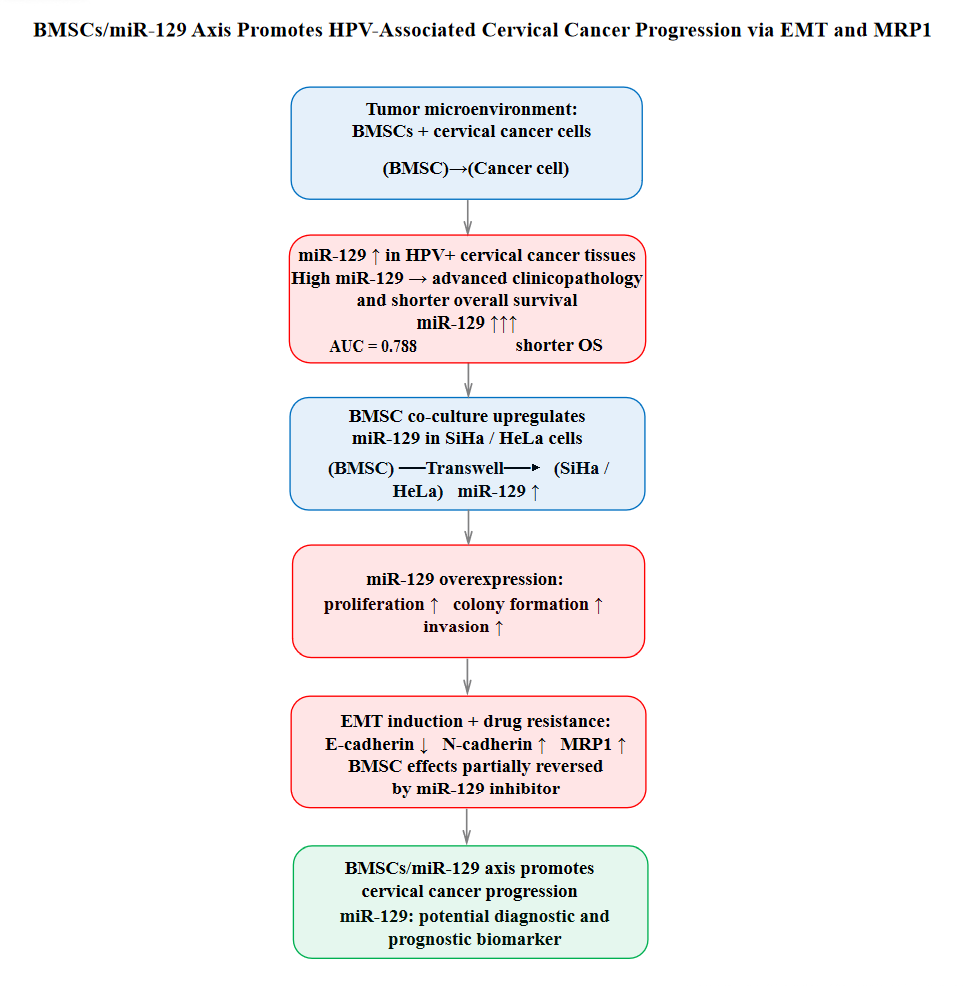
blot) were examined. Results: miR-129 expression was significantly
higher in cervical cancer tissues than in normal controls (3.24±0.56 vs.
1.00±0.32, P<0.05). High miR-129 expression correlated with tumor size ≥3 cm
(P=0.009), FIGO stage III-IV (P=0.0034) and lymph node metastasis (P=0.038).
High expression was associated with shorter OS (median: 28.4 vs. 46.2 months;
HR=2.944, 95%CI:1.484-5.842, P=0.002). The AUC was 0.788 (95%CI:0.693-0.884),
with a cut-off of 1.85 (sensitivity:76.9%, specificity:70.4%). BMSC co-culture
upregulated miR-129 expression (SiHa: 3.52±0.42 vs. 1.00±0.08, P<0.01).
miR-129 overexpression promoted proliferation, colony formation and invasion,
while knockdown suppressed these phenotypes. Overexpression of miR-129 reduced
E-cadherin (0.42±0.05 vs. 1.00±0.08, P<0.01) and increased N-cadherin
(2.85±0.22 vs. 1.00±0.10, P<0.01) and MRP1 (2.46±0.18 vs. 1.00±0.09,
P<0.01). Knockdown of miR-129 partially reversed BMSC-induced changes in
these proteins. Conclusion: miR-129 is significantly
upregulated in HPV-associated cervical cancer and shows potential as a
diagnostic and prognostic biomarker. BMSCs upregulate miR-129 in cervical
cancer cells and miR-129 modulates proliferation, invasion, EMT marker
expression and MRP1 expression. These findings suggest that the BMSCs/miR-129
axis may contribute to cervical cancer progression, but further in-vivo and mechanistic studies are
needed.
Keywords
BMSCs
EMT
HPV
Infiltration
miR-129
Molecular mechanism