original articles
Integrated network
pharmacology and experimental validation reveal the anti-inflammatory
mechanisms of Wuwei Shaji Powder in hepatic ischemia–reperfusion injury
Jucun Huang, Dan Dai
Available Online Date: 09 Oct 2026
Abstract
Abstract: Background: Hepatic ischemia–reperfusion injury (HIRI) is
primarily mediated by oxidative stress and inflammatory activation, yet
effective pharmacological interventions remain limited. Objectives:
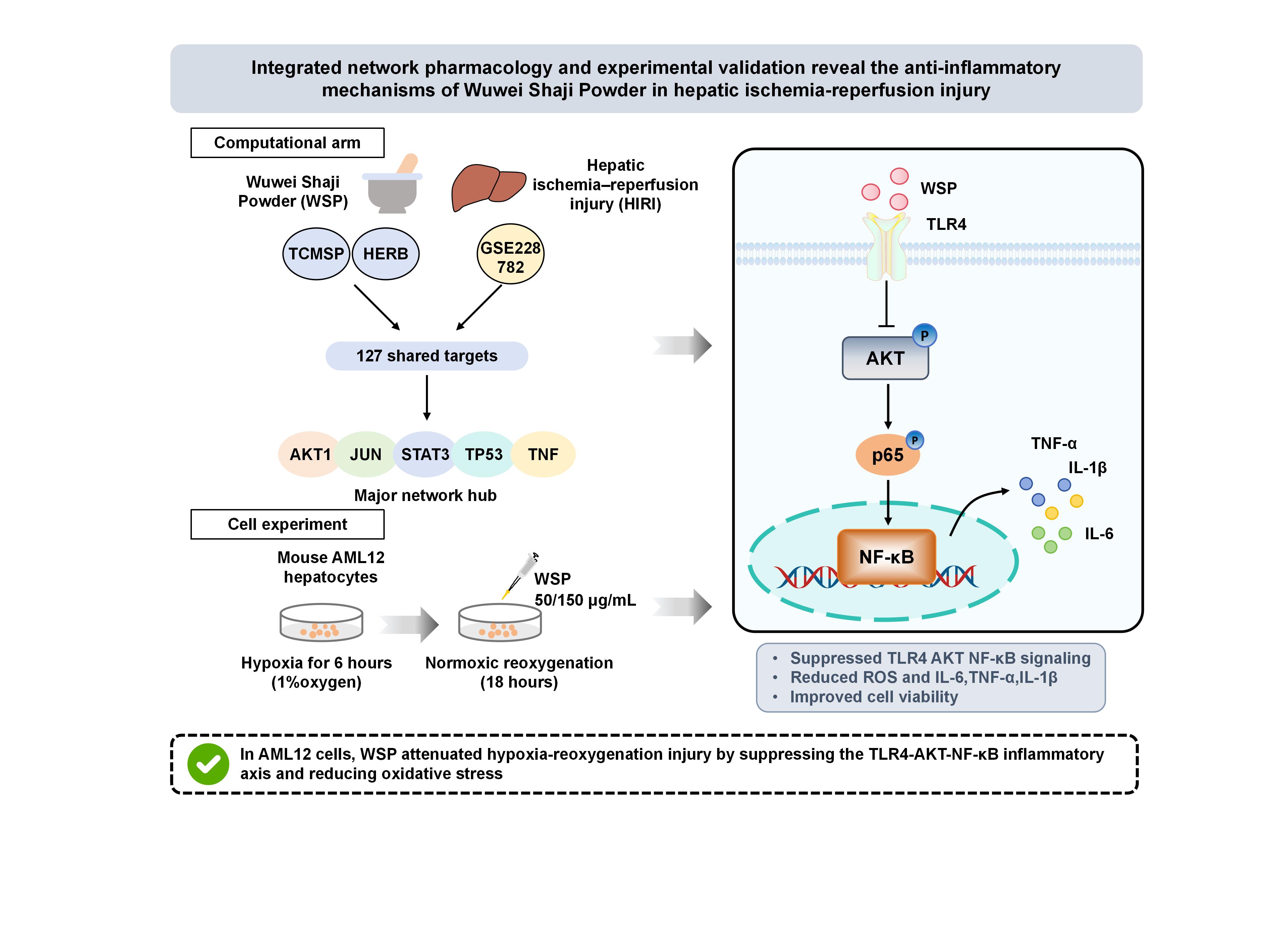
This study aimed to elucidate the key active ingredients, hub targets and
molecular pathways through which Wuwei Shaji Powder may exert anti-inflammatory
effects in HIRI using integrated network pharmacology and experimental
validation. Methods:
Active components of WSP and their predicted targets were obtained from TCMSP
and HERB, while HIRI-related genes were obtained from GeneCards, OMIM and
analysis of differential expression for the GEO dataset GSE228782.
Differentially expressed genes were identified using the thresholds of |log2FC|
≥ 1 and adjusted P-value, also known as false discovery rate (FDR), < 0.05.
Common targets underwent GO and KEGG enrichment, PPI network construction and
molecular docking. Subsequently, functional verification was performed using a
hypoxia/reoxygenation (H/R) model in AML12 cells treated with low- or high-dose
WSP. Cell viability, inflammatory cytokines, ROS levels and protein expression
of TLR4, AKT1, p-AKT (Ser473) and p-NF-κB were evaluated. Results: Network analysis highlighted
inflammation- and immunity-related pathways, with AKT1, TNF, JUN, STAT3 and
TP53 characterized as potential core regulatory
targets. Docking results indicated favorable binding between selected WSP
components and AKT1. Experimental data demonstrated that WSP significantly
restored cell viability (P < 0.001), reduced IL-6, TNF-α and IL-1β secretion
(all P < 0.001), attenuated ROS accumulation (P < 0.001) and suppressed
activation of the TLR4–AKT1–NF-κB axis, as indicated by reduced protein levels
of TLR4, p-AKT (Ser473) and p-NF-κB (all P < 0.001). Conclusion: WSP mitigates HIRI-induced
inflammatory injury mainly by suppressing TLR4-mediated activation of the
AKT1/NF-κB signaling cascade, thereby attenuating ROS accumulation and
pro-inflammatory cytokine secretion (IL-6, TNF-α and IL-1β). The data furnish
mechanistic evidence for its therapeutic potential against
ischemia–reperfusion–triggered hepatic inflammation.
Keywords
Hepatic ischemia–reperfusion injury
Inflammation
Molecular docking
Network pharmacology
TLR4–AKT1–NF-κB pathway
Wuwei Shaji powder