original articles
Safety profile and
potential favorable reporting signals of liraglutide in patients with
ulcerative colitis: A FAERS pharmacovigilance and network pharmacology study
Keliang Liu, Xiaocui Chen, Chunyan Li, Yichuan Zhang
Available Online Date: 10 Oct 2026
Abstract
Abstract: Background: Liraglutide, a glucagon-like peptide-1
receptor agonist (GLP-1 RA), has preclinical anti-inflammatory and
barrier-protective effects, but its safety profile and potential favorable
reporting associations in ulcerative colitis (UC) remain uncertain. Objectives: To characterize liraglutide-associated
reports in patients with UC and explore biological pathways that may
contextualize the observed pharmacovigilance signals. Methods: Reports submitted to the U.S. Food and Drug
Administration Adverse Event Reporting System (FAERS) from January 1, 2013, to
December 31, 2025, were analyzed in which liraglutide was recorded as the
primary suspected drug and UC as the indication. Disproportionality was
assessed using the reporting odds ratio (ROR), proportional reporting ratio
(PRR), Bayesian confidence propagation neural network (BCPNN) and multi-item gamma Poisson shrinker (MGPS). Network pharmacology
identified shared targets, constructed a protein-protein interaction network
and performed Gene Ontology and Kyoto Encyclopedia of Genes and Genomes
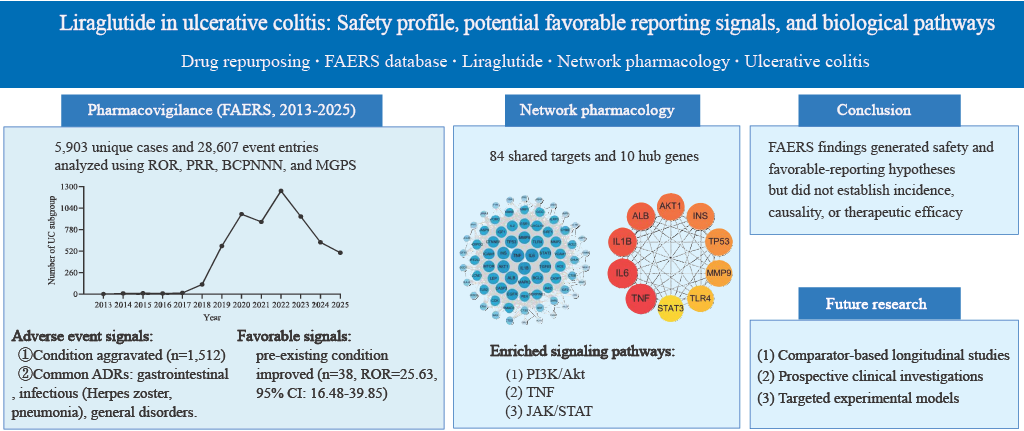
enrichment analyses. Results: Among 5,903 unique cases and 28,607 preferred-term event entries, the
most frequent categories were general disorders and administration-site
conditions, gastrointestinal disorders, injury or medication-related
complications, infections and investigations. The term “condition aggravated” was reported in
1,512 cases. Medication management, metabolic, infectious, neuropsychiatric and
gastrointestinal signals were also detected. Herpes zoster was reported in 154 cases and pneumonia-related reports
included eight fatal outcomes, although concomitant immunosuppressive therapy
substantially limited attribution. The reporter-coded term “pre-existing
condition improved” occurred in 38 cases (ROR 25.63; 95% confidence interval
16.48-39.85) and was interpreted only as an exploratory favorable reporting
association. Network pharmacology identified 84 shared candidate
targets and prioritized 10 hub genes. Enriched pathways included
phosphoinositide 3-kinase/protein kinase B, tumor necrosis factor and Janus
kinase/signal transducer and activator of transcription signaling. Conclusion: FAERS findings generated safety and favorable-reporting hypotheses but
did not establish incidence, causality, or therapeutic efficacy. The predicted
pathways provide biological context only and require confirmation in
comparator-based longitudinal studies, prospective clinical investigations and
targeted experimental models.
Keywords
Keliang Liu1#
Xiaocui Chen2#
Chunyan Li3 and Yichuan Zhang