original articles
Early
and late suppression of Toll-like receptor 4 signaling induces distinct changes
in a nephrotoxicant-induced mouse model of acute kidney injury
Yamna Haider, Rakhshinda Habib
Available Online Date: 12 Oct 2026
Abstract
Abstract: Background: Many essential genes in
different signaling pathways are significantly expressed in a stress- and time-dependent manner after acute kidney
injury (AKI). Despite their traditional role in driving inflammation, TLR
activation is increasingly recognized to promote renal epithelial repair by
inducing the secretion of specific interleukins and growth factors. Objectives: This study explored the effects of TLR4
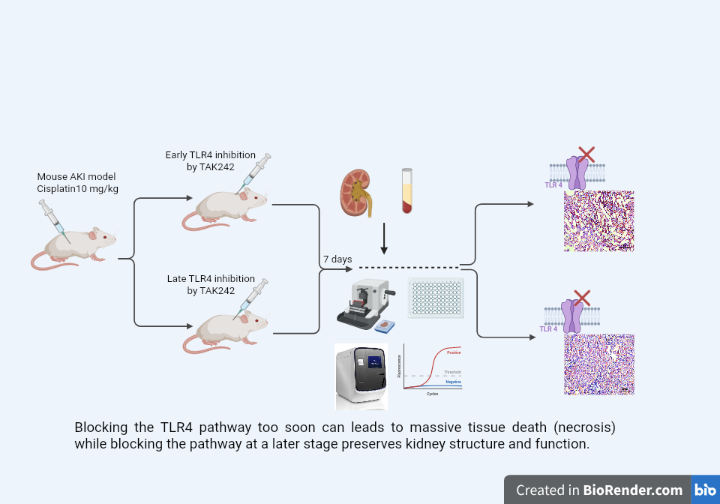
inhibition at early and late time points of cisplatin-mediated AKI. Methods: A mouse kidney injury model was developed
using a single dose of cisplatin (10 mg/kg) and treated with the TLR4 inhibitor
TAK-242 at either the initial or a later time point after cisplatin induction.
Kidney tissues were analyzed for histopathological and gene expression changes
by HE staining and qRT-PCR, respectively. Renal functional analysis was
performed by estimating serum creatinine levels in the control and all treated
groups. Results: Elevated
biochemical markers and serum creatinine levels correlated with histological
findings of tubular damage in all groups. Compared with the late intervention
group, we observed prominent tubular cell injury in the cisplatin AKI model and
the TAK242-early groups. Cisplatin significantly increased TLR4 expression in
the AKI model, which was abrogated in both TAK242-treated AKI groups. Compared
to the TAK242-early group, the late intervention group showed upregulation of Sod1 (p≤0.05), Hsp25 (p≤0.05), Nf-ĸb, Fzd8 and c-Met genes and downregulation of Il22 (p ≤0.001), Lcn2, and hsp70 gene expression.
Other genes, such as Hgf1, Wnt4 and Lc3 II, showed no
notable difference between the two intervention groups. Conclusion: The TLR4 pathway may be involved in immediate cell survival mechanisms
after injury, as massive necrosis and elevated serum creatinine were observed
following early inhibition of the TLR4 pathway, whereas late inhibition preserved
tissue architecture and function. Understanding the optimal timing of TLR
inhibition to achieve significant tissue protection can help underscore the
role of this pathway in AKI repair and its associated pathological processes.
Keywords
Acute kidney injury
Gene expression
Renal repair
Toll-like receptors
TLR4 inhibition