original articles
Impact
of paclitaxel-, docetaxel- and trastuzumab-based treatment according to Ki-67
and E-cadherin expression in invasive ductal and lobular breast carcinoma
Huixia Zhou, Li Zou, Wei Hu
Available Online Date: 13 Oct 2026
Abstract
Abstract: Background: Breast cancer is still the most common cause of
cancer death all over the world and invasive ductal carcinoma (IDC) and
invasive lobular carcinoma (ILC) are its two predominant histological subtypes.
Ki-67, a marker of cell proliferation and E-cadherin, an essential epithelial
cell–cell adhesion molecule, are common prognostic biomarkers that have proven
predictive values of response to taxane-based chemotherapy; however, the
significance of their gene expression in predicting benefit from taxane therapy
across various IDC and ILC subtypes in combination with targeted agents is
still less defined. Objectives:
This study was conducted to assess the predictive value of Ki-67 and E-cadherin
expression for treatment response, progression-free survival (PFS), and overall
survival (OS), whereas docetaxel- or paclitaxel-based chemotherapy with
trastuzumab in human epidermal growth factor receptor 2 (HER2)-positive
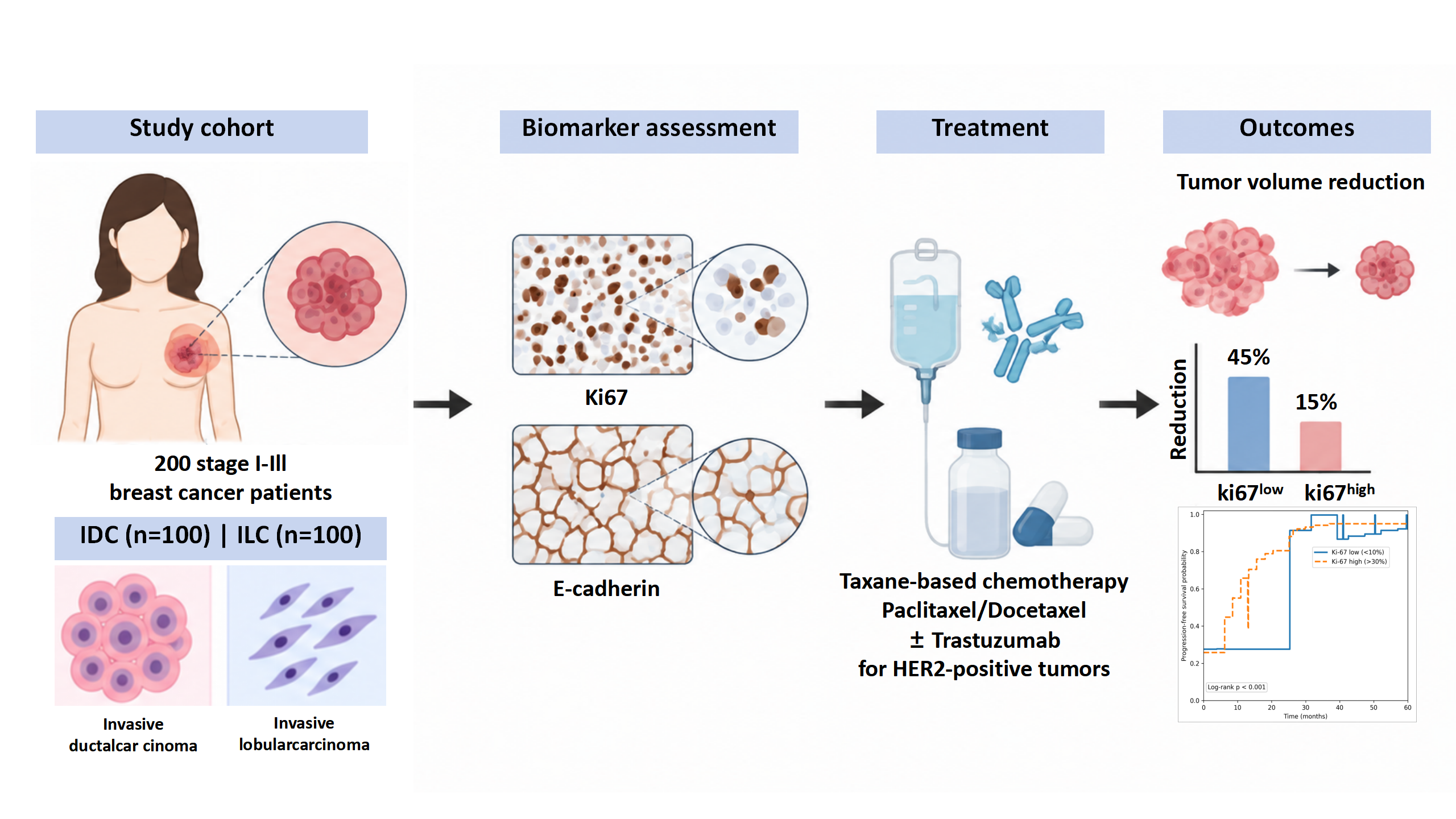
cases is used among patients with both IDC and ILC. Methods: The
study comprised 200 stage I–III breast cancer patients including 100 IDC and
100 ILC. Tumors were classified into low (30%) based on Ki-67 and E-cadherin
expression status, which was evaluated by immunohistochemistry (IHC). All patients
received one of the standard taxane-containing chemotherapy regimens with or
without trastuzumab for HER2-positive tumors. Eligibility for treatment was not
dependent on biomarker status. Tumor responses were determined according to the
RECIST criteria and OS was calculated by Kaplan–Meier estimates as well as
multivariate Cox regression analysis. Results: Low-dose-treated tumors with low Ki-67 showed significantly
higher percent tumor volume reduction (45%) than high Ki-67 tumors (15%; p <
0.01). The rates of complete response (CR) or partial response (PR) were
significantly higher in the presence than in the absence of E-cadherin (35% vs
20%; p = 0.04). Patients with a low Ki-67 index had a median PFS of 18 months
compared to ≥high Ki-67 group (9 months; p < 0.001). In HER2-positive
patients, median PFS was also longer in comparison with HER2-negative controls
(22 vs 15 months; p = 0.03). Conclusion: Ki-67 and E-cadherin expression for the prognosis of response as
well as survival in patients with IDC and ILC undergoing
taxane-based chemotherapy can be independently stratified. These results
imply that combining proliferation and adhesion markers may contribute to
personalized treatment decision-making beyond their prognostic implications.
Keywords
Breast cancer
E-cadherin
Ki-67
Survival
Taxane-based chemotherapy
Trastuzumab