original articles
Therapeutic role of norepinephrine infusion and 28-day mortality in
aneurysmal subarachnoid hemorrhage: A pharmaco-epidemiological cohort study
with overlap weighting
Peng Xue, Yu Xin Jiang, Xiao Yan Meng, Hai Quan Li, Da He Han, Yi Guo, Yu Jie Li
Available Online Date: 15 Oct 2026
Abstract
Abstract: Background:
Aneurysmal subarachnoid hemorrhage (aSAH) is frequently complicated by
hemodynamic instability and impaired cerebral perfusion, which may require
vasoactive support. However, the association between norepinephrine (NE)
exposure and short-term mortality in aSAH remains uncertain. Objectives: To evaluate the association
between NE infusion and 28-day all-cause mortality among patients with aSAH
treated with endovascular embolization, while accounting for baseline severity
and measured confounding. Methods:
This single-center retrospective cohort study included consecutive patients
with aSAH who underwent endovascular embolization at The Second Affiliated
Hospital of Xuzhou Medical University, Xuzhou, Jiangsu Province, China, from
January 1, 2022 to August 31, 2025. Patients were classified according to NE
administration during the acute hospitalization. The primary outcome was 28-day
all-cause mortality. Survival was compared using Kaplan-Meier curves and
log-rank tests. Cox proportional hazards models were fitted in crude, adjusted
and fully adjusted forms. Propensity score-based overlap weighting was applied
as a sensitivity analysis to improve covariate balance; balance was evaluated
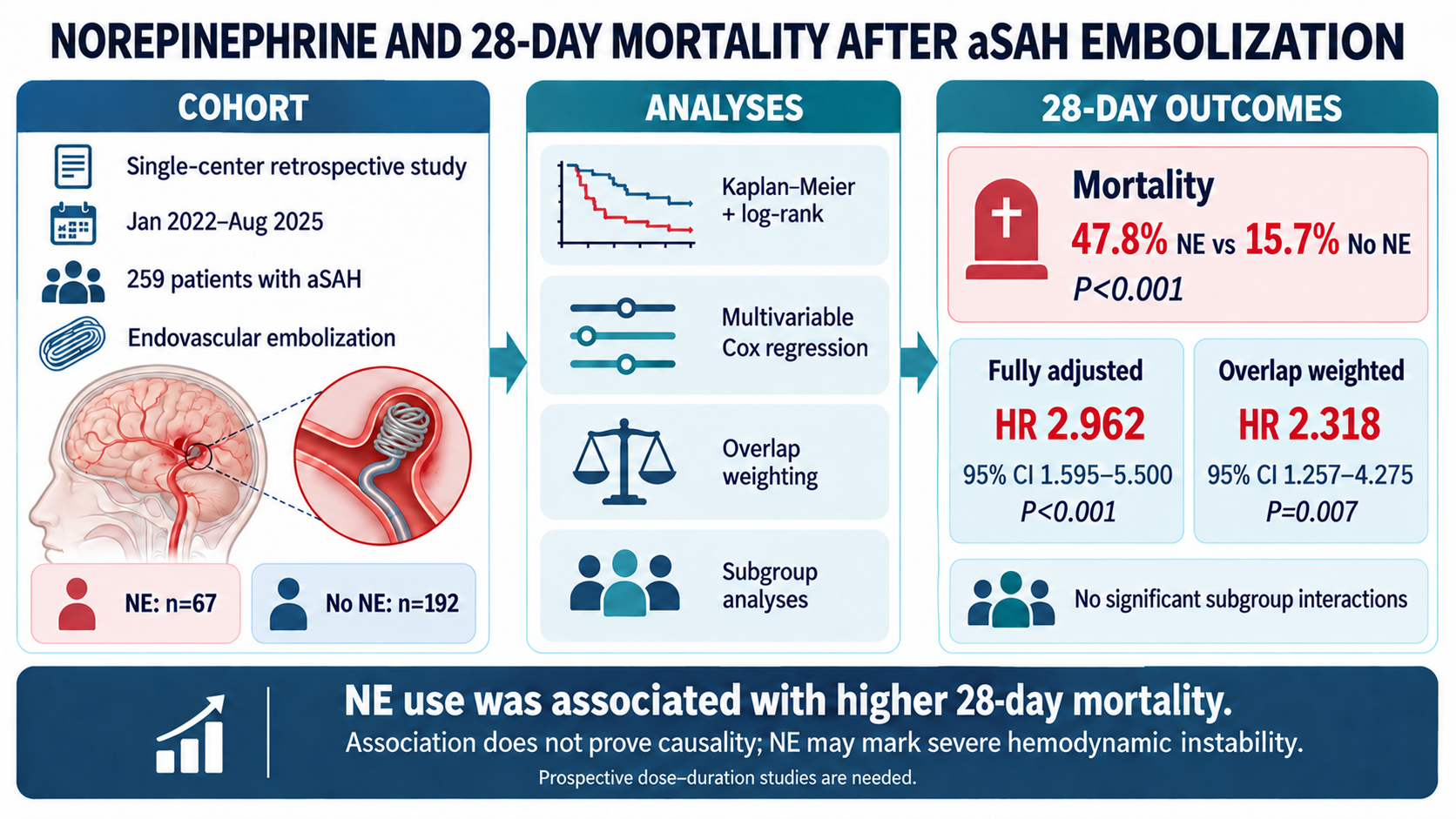
using standardized mean differences (SMDs). Results: A total of 259 patients were included in this
study, of whom 67 received norepinephrine. The 28-day mortality rate was higher
in the NE group than in the non-NE group (47.8% vs. 15.7%, P<0.001). After
full adjustment for laboratory and other relevant covariates, NE use remained
associated with an increased risk of 28-day mortality (HR=2.892, 95% CI: 1.566-5.338, P<0.001). Consistent results were observed
in the overlap-weighted (OW) analysis (HR=2.211, 95% CI: 1.218-4.015, P=0.009). No significant interactions were identified in the subgroup
analyses.Conclusion: NE
infusion was associated with higher 28-day mortality in patients with aSAH.
Because NE use may also indicate severe hemodynamic instability, these findings
should be interpreted as an association rather than proof of causality.
Prospective studies with detailed dose-duration data are needed.
Keywords
Mortality
Norepinephrine
Propensity score
Survival analysis
Subarachnoid hemorrhage