original articles
The effect of
alternating use of enteric-coated aspirin and clopidogrel on gastrointestinal
symptoms and patient compliance in elderly patients with coronary heart disease
Xiaoqing Dai, Jiali Yu
Available Online Date: 17 Oct 2026
Abstract
Abstract: Background: Dual antiplatelet therapy
(DAPT) is essential for secondary prevention of coronary artery disease (CAD),
but gastrointestinal (GI) intolerance often leads elderly patients to self-reduce
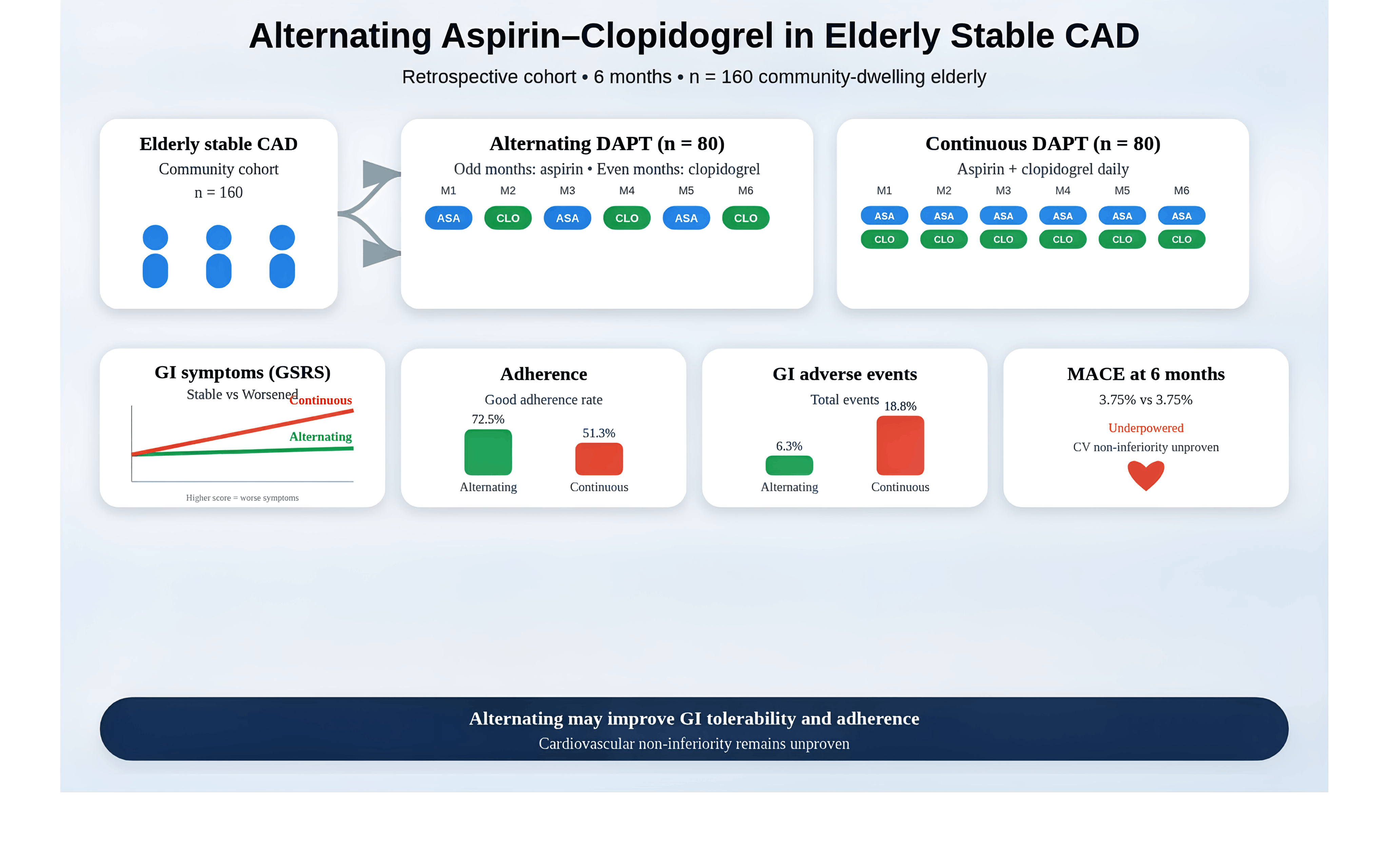
the dose or discontinue medication. Objectives: To compare the effects of monthly alternating aspirin and
clopidogrel versus continuous DAPT on GI symptoms, medication adherence and 6‑month
major adverse cardiovascular events (MACE) in elderly community patients with
stable CAD. Methods: This
retrospective cohort study included 160 elderly patients with stable CAD, who
were non-randomly assigned to alternating DAPT (n=80) or continuous
DAPT (n=80) according to their documented antiplatelet regimens in
clinical practice. GSRS, MMAS-8 and adverse events were evaluated at baseline
and 6 months. Results:
At 6 months, the
observation group’s GSRS total score remained stable (15.14±4.52 to 15.84±4.89,
+0.70, P>0.05), while the control group significantly worsened
(15.18±4.48 to 19.59±5.67, +4.41, P<0.05); the between-group difference
was significant (P<0.05). The MMAS-8 score was higher in the
observation group (7.58±0.76 vs. 6.94±1.15, P<0.001), with higher adherence
rates (72.50% vs. 51.25%, P=0.006). Total GI adverse events were lower
in the observation group (6.25% vs. 18.75%, P=0.017), but GI bleeding
did not differ significantly. MACE occurred in 3 cases (3.75%) in each group (P=1.000);
however, statistical power was severely insufficient to infer cardiovascular
non‑inferiority. Conclusion: Alternating
monthly use of aspirin and clopidogrel during the 6-month observation period of
this study did not show a significant increase in the risk of MACE. Under these
conditions, this regimen attenuated the progressive worsening of gastrointestinal symptoms in
elderly patients (scores remained stable rather than significantly worsening) and significantly improved
medication adherence. Within this study's specific population (stable elderly
CAD patients) and 6-month observation window, this strategy offers a promising
alternative worthy of further investigation. Its long-term benefits and
cardiovascular safety require confirmation by prospective large-scale trials.
Keywords
Aspirin enteric-coated tablets
Alternation
Aged
Antiplatelet therapy optimization
Clopidogrel
Medication adherence
Primary care
Stable coronary artery disease