original articles
Synthesis and characterization of
ligustrazine-acylhydrazone derivatives and their inhibitory activity against
human lung cancer A549 cells
Ting Wang, Ji-Wen Sheng, Yu-Jie Yang, Jun-Qi Tan, Kun Liu, Chu Chu, Sheng-Yu Li, Yue-Yue Dou, Hong-Wei Li, Dong-Mei Liu
Available Online Date: 23 Oct 2026
Abstract
Abstract: Background:
Ligustrazine is a pivotal active component of Ligusticum wallichii
Franch; it is used clinically for treating cardiovascular diseases. Derivatization
of ligustrazine might promote its biological activities and bioavailability. Objectives:
A series of ligustrazine-acylhydrazone
derivatives (TMPAD-1–TMPAD-13)
were synthesized and their inhibitory activity against A549 cells was
investigated. Methods: These derivatives were synthesized by condensing
aromatic aldehydes with ligustrazine-based hydrazides to form acylhydrazone
bonds and their chemical structures were characterized through a combination of
spectral methods, including Fourier transform infrared (FT-IR) spectroscopy,
electrospray ionization high resolution mass spectrometry (ESI-HRMS), 1H
and 13C nuclear magnetic resonance (NMR) spectra. Results: In-vitro
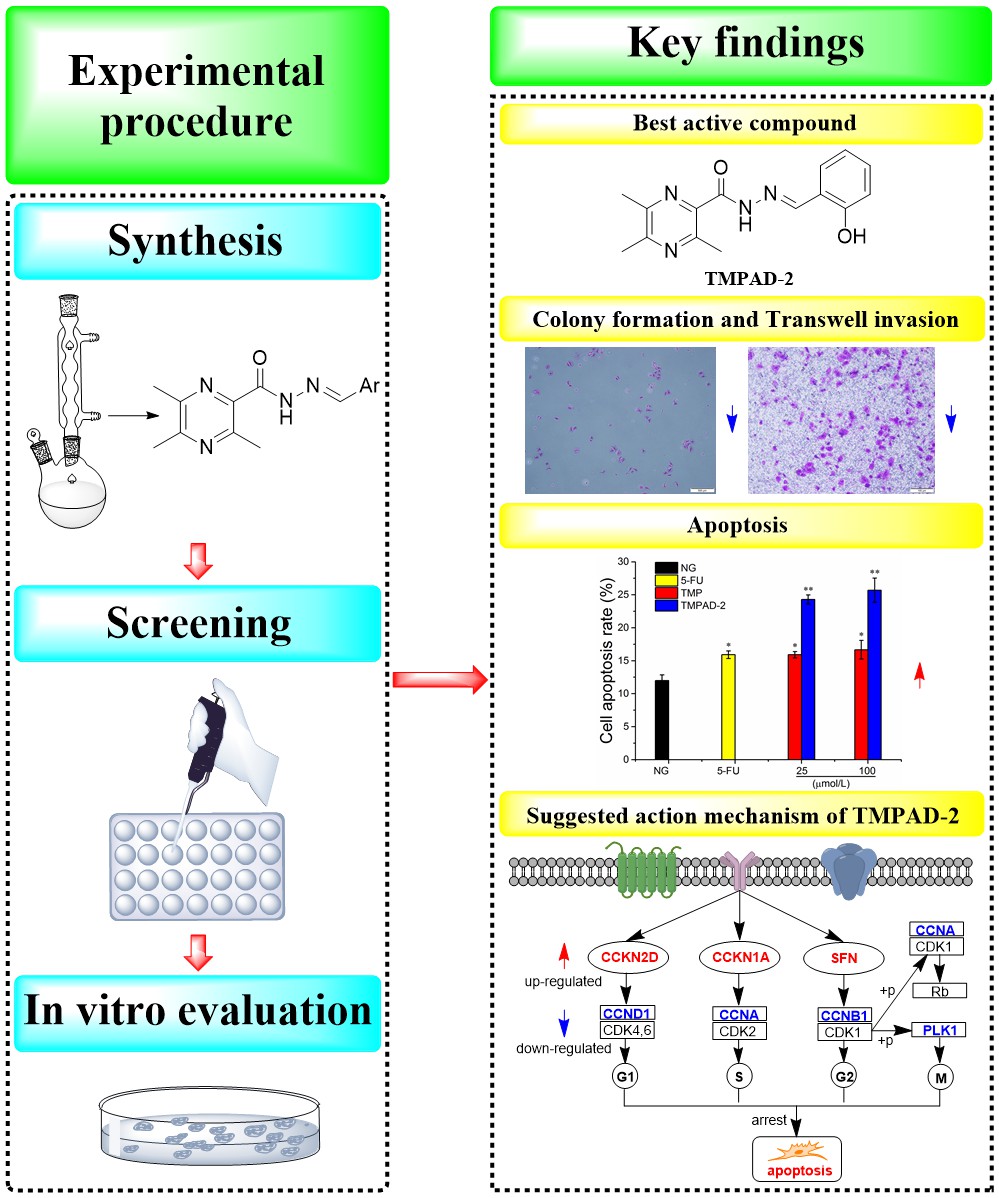
experimental results displayed that TMPAD-2
exhibited marked inhibitory activity against A549 cells as shown by impeding cell
proliferation (IC50 = 48.08 μmol/L), colony formation (colony forming efficiency ≤
1.5 ± 0.02%), invasion and migration, enhancing tumor necrosis factor (TNF)-α
and reactive oxygen species (ROS) levels, decreasing interleukin (IL)-6 and
mitochondrial membrane potential (MMP) levels, hindering cell cycle
progression and inducing apoptosis. RNA-sequencing (RNA-seq) analysis
disclosed 17 lung cancer-related differentially expressed genes (DEGs). These
results were statistically supported with significant p-value. Conclusion: These results suggest that dysregulation of the
cyclin–cyclin-dependent kinase (CDK)–cyclin-dependent kinase inhibitor (CKI)
regulatory network is primarily responsible for the inhibitory action
of TMPAD-2 on A549 cells. Current
findings might provide valuable insights for further development of
ligustrazine derivatives as novel anticancer agents.
Keywords
Acylhydrazone derivative
cyclin–CDK–CKI pathway
Ligustrazine
RNA sequencing