original articles
Correlational analysis of TRAF5-JNK and integrin
β1-FAK signaling in human lung fibroblasts cultured on decellularized fibrotic
versus normal lung extracellular matrix
YuMei Liu, Jing Shao, Meng Zhao, YuBao Wang
Available Online Date: 29 Oct 2026
Abstract
Abstract: Background:
Pulmonary fibrosis involves
pathological remodeling of the extracellular matrix (ECM), which actively
influences fibroblast behavior. The specific signaling pathways associated with
fibrotic ECM-driven fibroblast activation remain incompletely defined. In particular, TNF receptor-associated factor 5 (TRAF5), a
signaling adaptor traditionally studied in immune cells, has never been
investigated as an ECM-responsive molecule in fibroblasts. Objectives: To investigate the effects of
decellularized normal (N-ECM) and fibrotic (F-ECM) lung ECM on human lung
fibroblast (HLF) metabolic activity and activation phenotype and to quantify
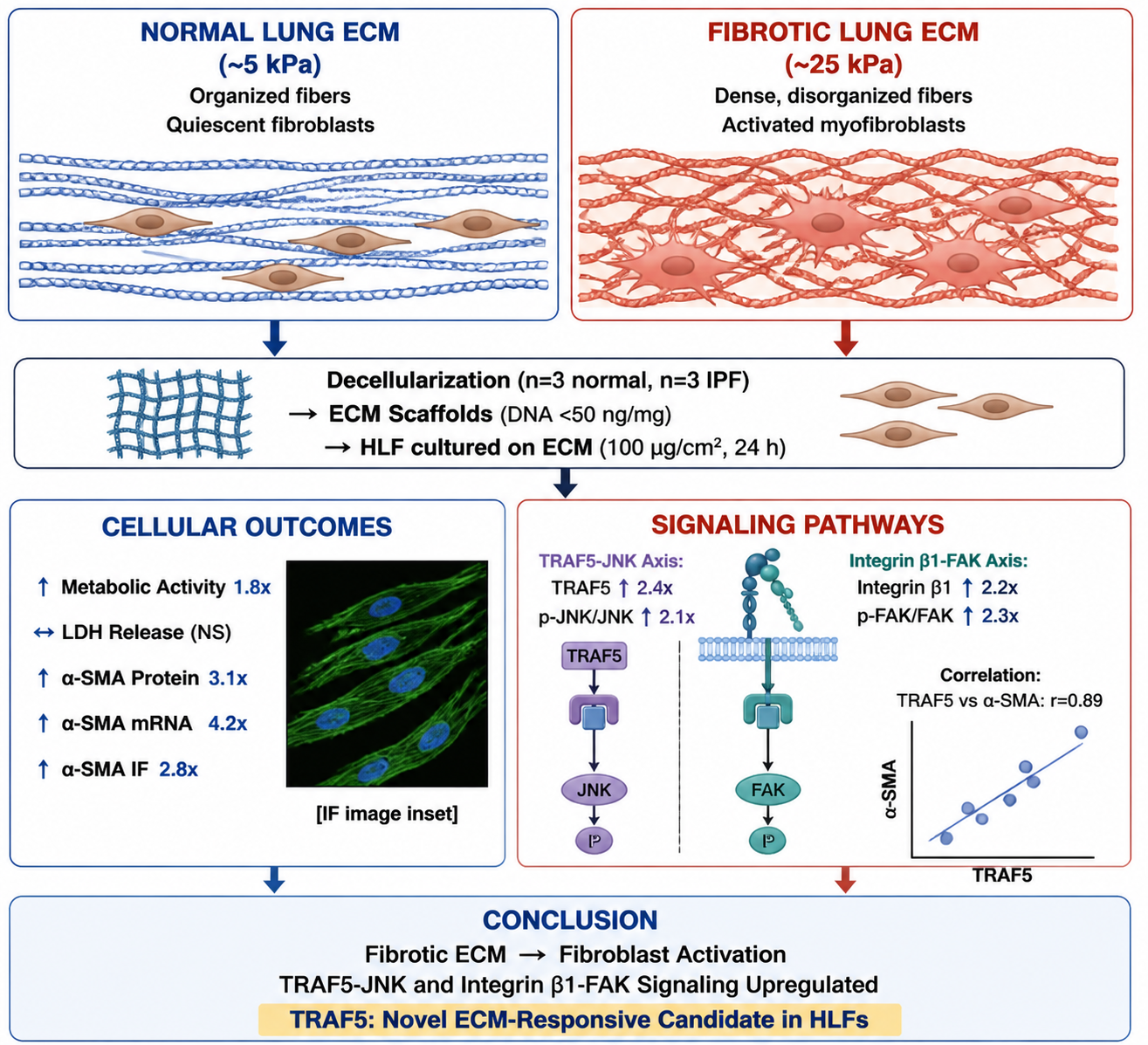
associations with TRAF5-JNK and integrin β1-FAK signaling. Methods: Decellularized ECM scaffolds
were prepared from normal (n=3) and fibrotic (IPF, n=3) human lung tissues,
validated by DNA quantification (<50 ng/mg) and histology. Primary HLFs were
cultured on ECM-coated plates (100 μg/cm²) for 24 hours. Metabolic activity was
assessed by CCK-8 (with ECM-only controls); cytotoxicity by LDH release;
protein expression by Western blot with densitometric normalization to GAPDH
and total protein (p-JNK/JNK, p-FAK/FAK ratios); mRNA by qPCR; and α-SMA
localization by immunofluorescence with ImageJ quantification. Pearson correlation analysis was performed to explore
relationships between pathway components and activation markers. Results: F-ECM significantly increased
HLF metabolic activity compared to Control (1.8-fold, 95% CI: 1.5–2.1,
P<0.01) without elevating LDH release (P>0.05). ECM-only control wells
showed no CCK-8 interference (OD450 < 0.05). Densitometric analysis
demonstrated that F-ECM increased TRAF5 protein (2.4-fold, P<0.01),
p-JNK/JNK ratio (2.1-fold, P<0.05), integrin β1 (2.2-fold, P<0.01) and
p-FAK/FAK ratio (2.3-fold, P<0.01) compared to Control. The α-SMA protein
(3.1-fold, P<0.01) and mRNA (4.2-fold, P<0.01) were also upregulated. TRAF5 and α-SMA protein expression showed a strong
positive correlation (r=0.89, 95% CI: 0.71–0.96, P<0.001).
Immunofluorescence confirmed increased α-SMA fluorescence intensity (2.8-fold,
P<0.01) and spindle-shaped morphological changes in F-ECM-treated cells. Conclusion: Decellularized fibrotic lung
ECM is associated with increased fibroblast metabolic activity and activation
marker expression, correlating with upregulated TRAF5-JNK and integrin β1-FAK
signaling. These correlational findings provide
hypothesis-generating evidence for ECM-driven mechanisms in pulmonary fibrosis
but require validation through pathway inhibition or gene knockdown studies to
establish causality. TRAF5 is identified as a candidate ECM-responsive
signaling molecule warranting further mechanistic investigation.
Keywords
Decellularized matrix
Extracellular matrix
Fibroblast activation
Integrin β1-FAK signaling pathway
Pulmonary fibrosis
TRAF5-JNK signaling pathway