original articles
Gene–pathway–organ perspective on quercetin in
diabetic complications: A narrative review of preclinical evidence
Jie Zhan, Zhixin Chen, Bowen Zhang, Xiaojuan Wen, Yujing Chen, Yanyan Zhu, Ming Thong Ong, Fangying Chen, Xiaohua Chen
Available Online Date: 01 Nov 2026
Abstract
Abstract: Diabetic complications involve multiple mechanisms, including metabolic
disorders, oxidative stress, inflammation, fibrosis and apoptosis. Quercetin
possesses multi-target regulatory potential, but relevant preclinical evidence
remains scattered across different organs and signaling pathways. This
narrative review aims to synthesize rodent evidence on quercetin-related genes,
signaling pathways and organ protection in diabetic complications from a
gene–pathway–organ perspective. Relevant rodent studies published from
inception to June 2025 were searched in PubMed, EMBASE, Web of Science,
Cochrane Library and Springer Link databases. Seventy-eight studies were
included after screening. Due to significant heterogeneity among studies, a
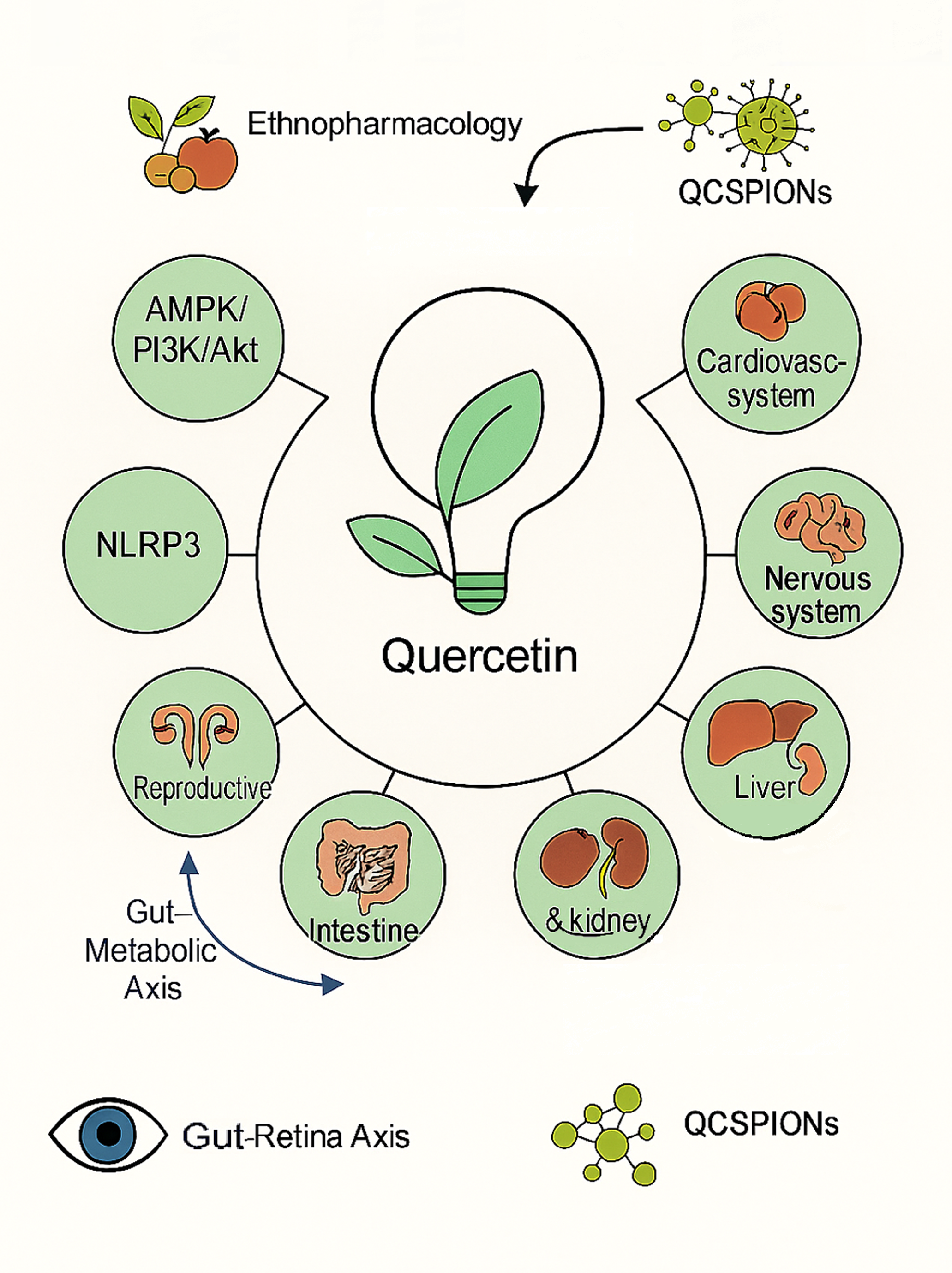
narrative approach was used for evidence synthesis. Quercetin mainly regulates
pathways such as AMPK, PI3K/Akt, Nrf2/HO-1, NF-κB, TGF-β/Smad3, SIRT1 and NLRP3
and is involved in metabolic, cardiovascular, hepatic, renal, nervous,
intestinal, wound-healing, reproductive and retinal systems. Evidence is strong
in the metabolic-cardiovascular, hepatic and renal systems, moderate in the
nervous and intestinal systems and limited in other systems. Current animal
evidence suggests that quercetin may act as a multi-target regulator in the
intervention of diabetic complications. This "gene-pathway-organ"
framework can serve as a hypothesis-generating tool to identify key molecular
hubs, compare the strength of evidence across different organs and guide
subsequent mechanism validation and translational research.
Keywords
Diabetes mellitus
Diabetic complications
Narrative review
Quercetin
Signaling pathways