original articles
Silica nanoparticle-delivered astragaloside IV promotes oxidative stress and apoptosis in prostate cancer cells via the miR-125-5p/STIR4 axis
Chungping Yang, Peihsin Shie, Zhenye Xu
Available Online Date: 02 Nov 2026
Abstract
Abstract: Background: Prostate cancer (PCa) treatment is limited by drug
resistance and toxicity. Astragaloside IV (AIV) has anti-tumor activity but
poor bioavailability. Objectives:
To prepare silica nanoparticle-loaded astragaloside IV (SN-AIV) and
to investigate whether it induces oxidative stress and apoptosis in PC-3
cells via the miR-125-5p/STIR4 axis. Methods: SN-AIV was prepared and characterized. PC-3 cells were
treated with SN-AIV, free AIV, or controls. Cell viability, apoptosis,
mitochondrial function and oxidative stress markers were assessed. qRT-PCR and
Western blot detected miR-125-5p and STIR4 expression. A dual-luciferase
reporter assay confirmed target binding. Functional rescue experiments were
performed. Results: SN-AIV exhibited uniform size (98.4 ± 6.2 nm) and sustained release.
Compared with controls, SN-AIV significantly reduced cell viability, induced
apoptosis, decreased mitochondrial membrane potential, increased MDA and
decreased SOD and GSH levels. SN-AIV up-regulated miR-125-5p and down-regulated
STIR4. STIR4 was confirmed as a direct target of miR-125-5p. miR-125-5p
overexpression or STIR4 knockdown mimicked SN-AIV effects, while miR-125-5p
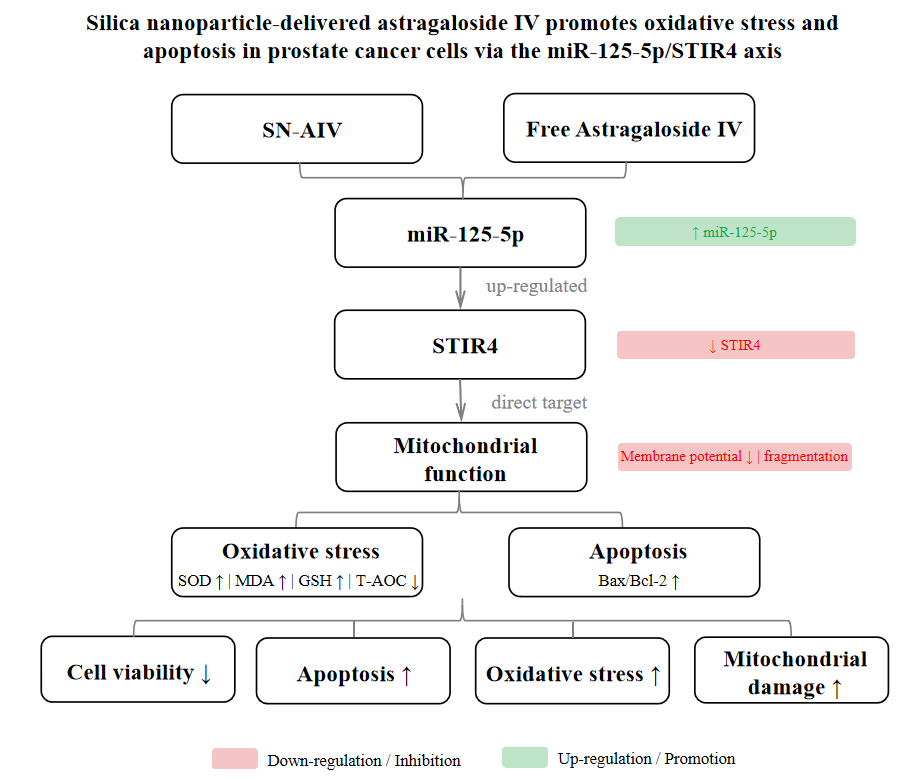
inhibition reversed them. Conclusion: SN-AIV induces oxidative stress and apoptosis in PC-3
cells by up-regulating miR-125-5p and down-regulating STIR4, providing an
experimental basis for nanoparticle-delivered AIV in PCa treatment.
Keywords
Astragaloside IV
miR-125-5P
Prostate cancer
Silica nanoparticles
STIR4