original articles
Comprehensive analysis of the therapeutic effect of lipid-coated hybrid nanoparticles for breast cancer therapy
Tehreem Arshad, Muhammad Ovais Omer, Ali Sharif, Adeel Sattar, Arfan Ahmad, Imran Tariq, Sajid Ali
Available Online Date: 02 Nov 2026
Abstract
Abstract: Background: Nanoparticles have gained
considerable attention as versatile platforms for the diagnosis and treatment
of different diseases, particularly cancer. Lipid-coated hybrid nanoparticles
(LCHNPs), comprising a polymeric core enveloped by a lipid shell, offer improved
targeting and potential solutions for multidrug-resistant cancers. Objective: To develop and preclinically
evaluate a dual-drug LCHNP system co-delivering Tamoxifen and Gemifloxacin for
enhanced breast cancer therapy. Methods: An experimental in-vitro and in-vivo study was
conducted to develop and evaluate lipid-coated hybrid nanoparticles (LCHNPs)
co-delivering Tamoxifen and Gemifloxacin using MCF-7 cells and a DMBA-induced
mammary tumor model in female Albino Wistar rats.Poly(lactic-co-glycolic acid)
(PLGA) nanoparticles loaded with Tamoxifen were prepared by the solvent
evaporation method and liposomes loaded with Gemifloxacin were prepared by the
thin-film hydration technique. The two systems were subsequently fused to
generate LCHNPs. Physicochemical and structural characterization was carried
out using dynamic light scattering (DLS), Fourier transform infrared
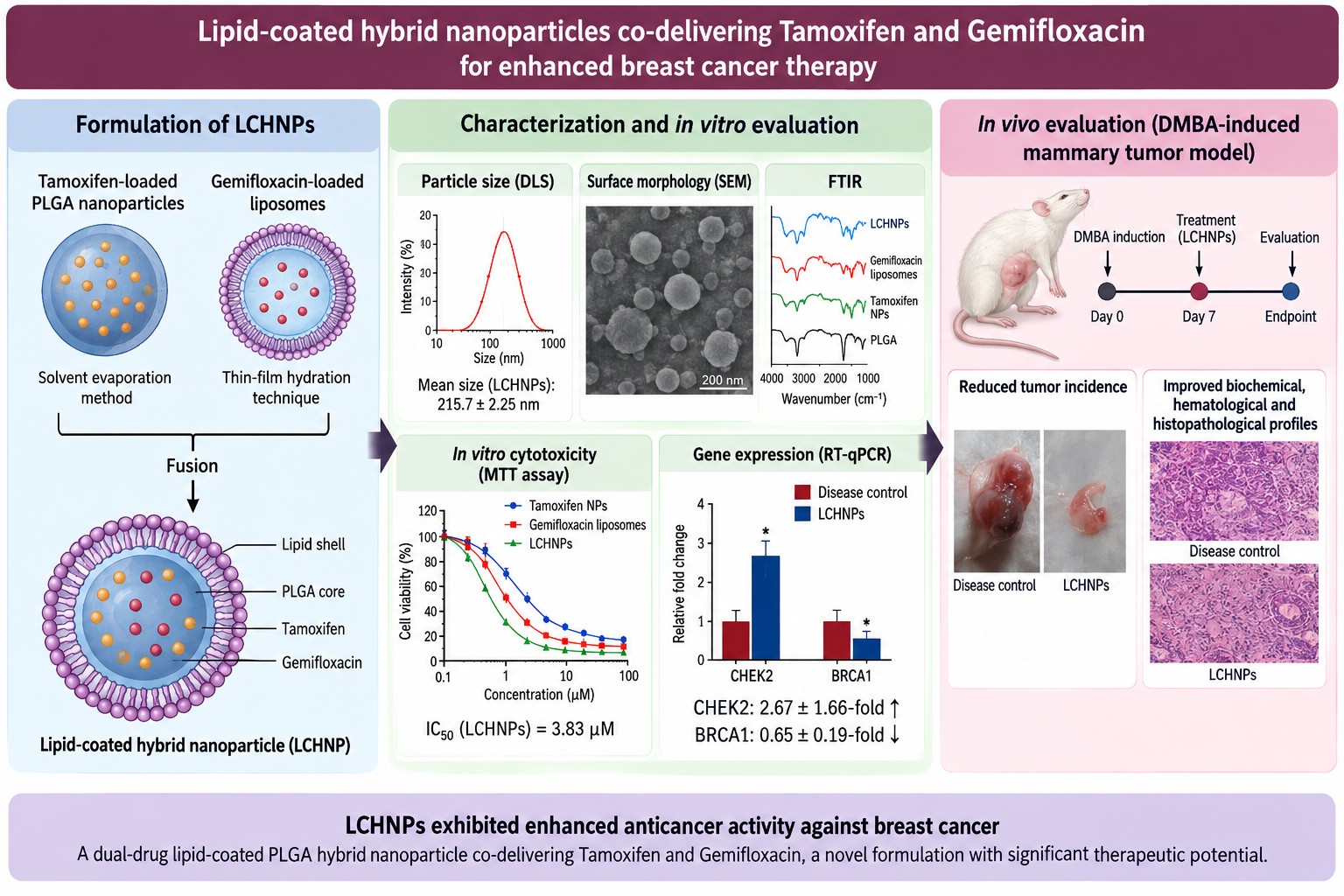
spectroscopy (FTIR) and scanning electron microscopy (SEM). Results: The mean particle sizes of Tamoxifen
nanoparticles, Gemifloxacin liposomes and LCHNPs were 175.3 ± 1.97 nm, 201.2 ±
2.45 nm and 215.7 ± 2.25 nm, with zeta potentials of +5.5 mV, −12.9 mV and +0.6
mV, respectively. Encapsulation efficiencies reached 96.41 ± 0.66% for
nanoparticles and 91.22 ± 1.1% for liposomes. FTIR confirmed successful drug
incorporation, while SEM imaging demonstrated smooth particle surfaces. LCHNPs
exhibited the lowest IC50 value among the tested formulations (IC₅₀ =
3.83 µM). RT-qPCR (quantitative reverse transcription polymerase chain
reaction) analysis demonstrated a significant upregulation of CHEK2
(2.67 ± 1.66-fold) and downregulation of BRCA1 (0.65 ± 0.19-fold) in the
LCHNP-treated group compared with the disease control. In-vivo evaluation in a DMBA
(dimethylbenz[a]anthracene)-induced mammary tumor model in female Albino
Wistar rats (n = 6/group) confirmed the enhanced antitumor efficacy of LCHNPs,
as evidenced by reduced tumor incidence and favorable biochemical,
hematological and histopathological profiles. Conclusion: Lipid-coated hybrid nanoparticles
exhibited enhanced anticancer activity. This study provides a preclinical
evaluation of a dual-drug lipid-coated PLGA hybrid nanoparticle co-delivering
Tamoxifen and Gemifloxacin, a formulation that has not been previously reported
for breast cancer therapy.
Keywords
Breast cancer
Cytotoxicity
Gemifloxacin
Lipid-coated nanoparticles
Tamoxifen