original articles
Global research trends and therapeutic evolution
of biologic agents in allergic rhinitis: A bibliometric analysis
Xue Jiao Liu, Xu Hui Tai
Available Online Date: 03 Nov 2026
Abstract
Abstract: Background: Allergic rhinitis (AR) is a prevalent
immunoglobulin E (IgE)-mediated inflammatory disorder. Biologic agents are
increasingly discussed for severe or refractory AR, but the global publication
landscape and therapeutic evolution of this topic remain incompletely
characterized. Objectives: To map global research trends,
contributors, collaboration patterns and evolving biologic targets in AR from
2000 to 2025. Methods: English-language articles were
retrieved from the Web of Science Core Collection using Boolean combinations of
AR-related and biologic-agent terms. VOSviewer and the Bibliometrix R package
were used to analyze publication growth, journals, countries, institutions,
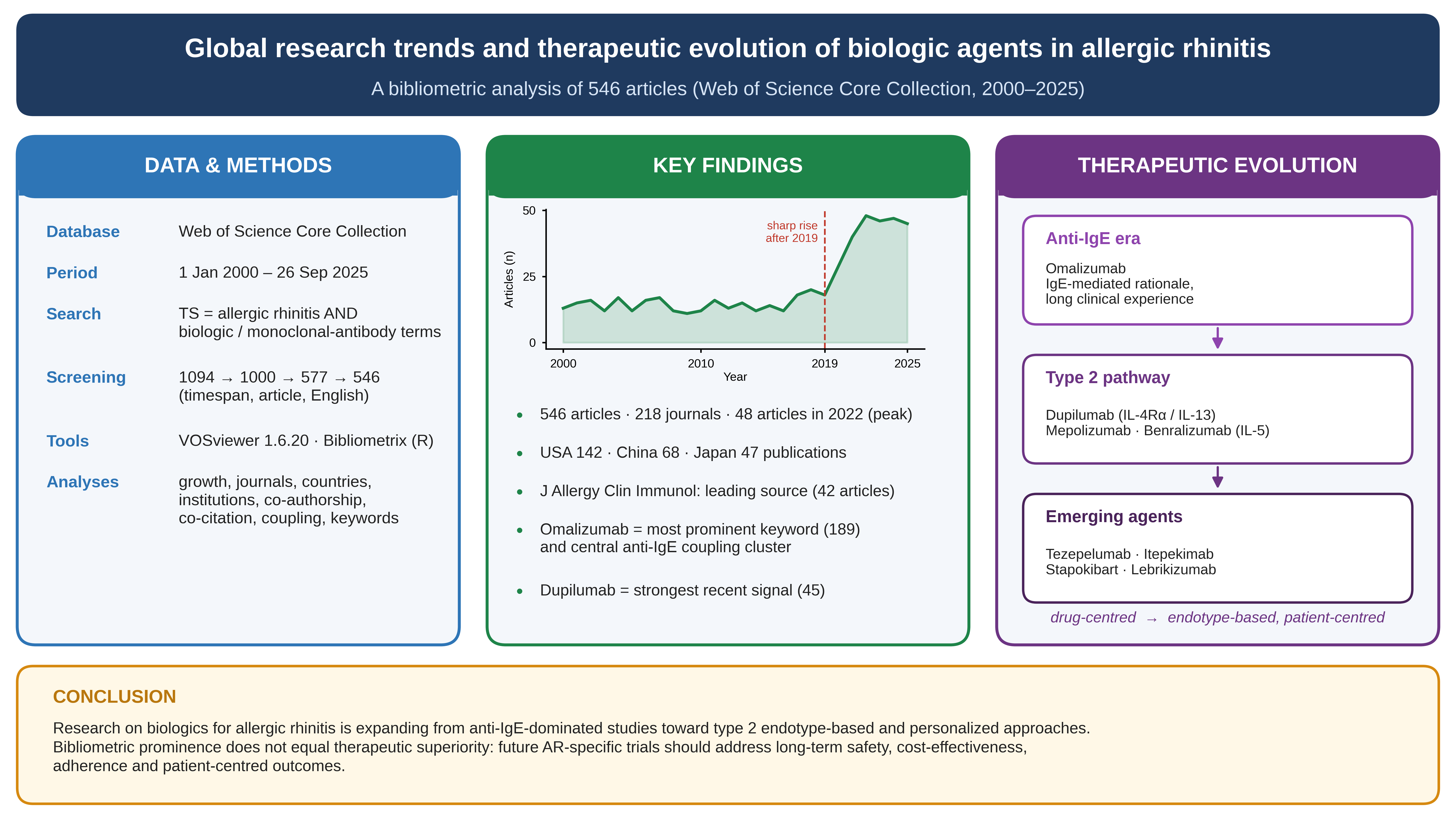
co-authorship, co-citation, bibliographic coupling and keyword co-occurrence. Results: A total of 546 articles were included. Publication output
increased sharply after 2019 and reached 48 articles in 2022; the exploratory
linear model showed moderate fit (R2=0.5599). The United States had
the highest publication count (142) and citations (7871), followed by China (68)
and Japan (47). The Journal of Allergy and Clinical Immunology was the leading
source (42 articles; 3720 cited-journal occurrences). Omalizumab was the most
prominent biologic keyword (189 occurrences) and anchored the central
anti-IgE/allergic-rhinitis coupling cluster (centrality 0.52; impact 3.74),
probably reflecting its early anti-IgE rationale, long clinical experience and
evidence base. Dupilumab showed a strong recent temporal signal (45
occurrences), while mepolizumab, benralizumab and newer agents such as
tezepelumab, itepekimab and stapokibart remained less represented. Conclusion: Research on biologic agents for AR is expanding from
anti-IgE-dominated studies toward type 2 endotype-based and personalized
approaches. Bibliometric prominence should not be interpreted as direct
therapeutic superiority and future AR-specific studies should evaluate
long-term safety, cost-effectiveness and patient-centered outcomes.
Keywords
Allergic rhinitis
Biological products
Bibliometrics
Dupilumab
Omalizumab