original articles
Comparative study of ultrasonic-assisted
extracts of twelve traditional medicinal plants for in-vitro assessment
of anticancer activity along with phytochemical and antioxidant potential
Sajjad Ali, Muhammad Riaz, Muhammad Shafique, Khurshid Anwar, Nayab Tahir, Hina Manzoor, Tahir Jamshaid, Muhammad Akram, Shahbaz Ahmad Zakki, Naila Bashir, Huaiji Zheng, Muhammad Jahangir, Inam-u-llah
Available Online Date: 04 Nov 2026
Abstract
Abstract: Background: Pakistan has 6,000 plant
species and several of these are known to have medicinal properties. However,
dozens of plants are still scientifically unexplored or under-explored for
their medicinal and therapeutic potential. Therefore, in the present study,
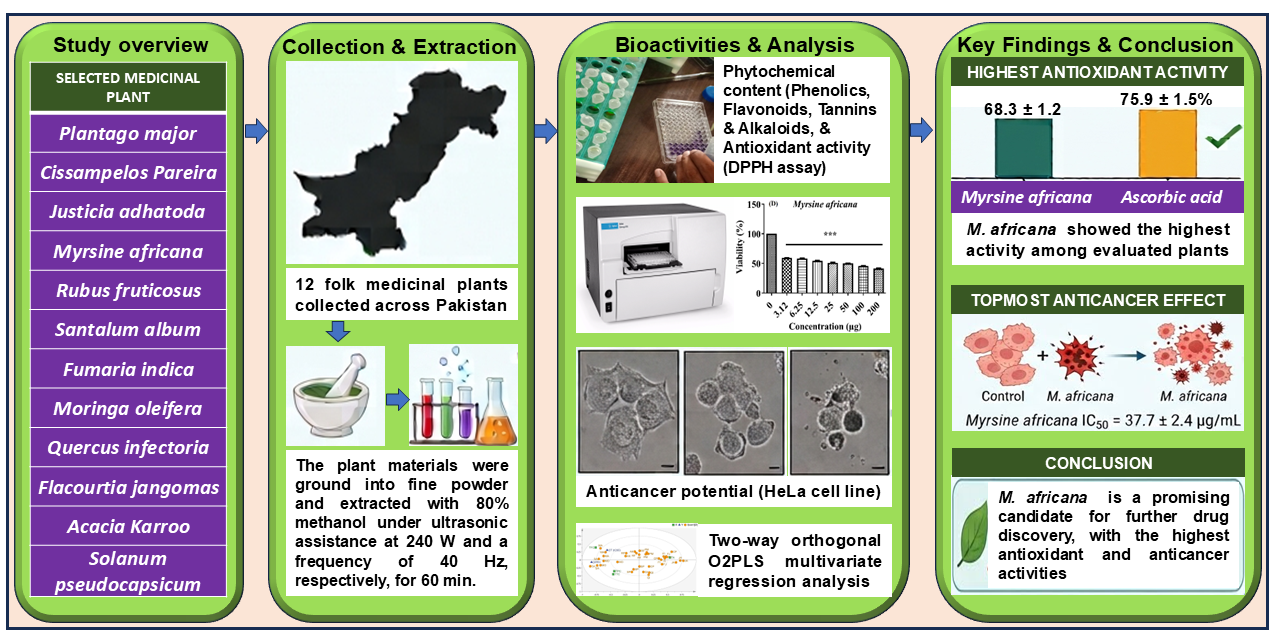
twelve folk medicinal plants, including Plantago major, Cissampelos
pareira, Justicia adhatoda, Myrsine africana, Rubus fruticosus, Santalum album,
Solanum pseudocapsicum, Fumaria indica, Moringa oleifera, Quercus infectoria,
Flacourtia jangomas and Acacia
karroo, were chosen. Objectives: The study aimed to assess phytochemical content, antioxidant
activity and anticancer potential. Methods: The extracts were prepared in 80% methanol under ultrasonic
assistance. The antioxidant activity was measured using the DPPH method and the
phytochemical content was evaluated following standard protocols. The cytotoxic
potential was assessed using the MTT colorimetric assay against the HeLa cell
line and multivariate regression analysis identified the common group (s) of
bioactive metabolites among the studied plants. Results: The extraction yield was
between 6.0% and 14.6%, depending on the plant material. Phytochemical analysis
revealed varying levels of phenolics, flavonoids, tannins and alkaloids. Among
all tested plants, M. africana exhibited the highest DPPH free
radical-scavenging activity at 68.3 ± 1.2%, just below ascorbic acid (75.9 ±
1.5%), while J. adhatoda had the lowest (42.3 ± 2.5%). The MTT assay
indicated that all plant extracts, except J. adhatoda, F. indica and F. jangomas, demonstrated
promising anticancer effects, with M. africana showing the most potent
activity (IC50 = 37.7 ± 2.4 µg/mL). The two-way orthogonal
PLS multivariate regression analysis identified phenolics and flavonoids as
important classes of phytochemicals present in M. africana, S. album and M. oleifera, responsible
for their potent antioxidant and cytotoxic properties. Conclusion: The results reveal that among
the studied plants, M. africana exhibits the most significant
antioxidant and cytotoxic potential. However, further research is recommended
to isolate and identify the specific antioxidant and anticancer compounds.
Keywords
Antioxidant activity
Cytotoxic activity
Medicinal plants
Phytochemicals
Principal component analysis