original articles
A machine learning–based senescence scoring
system reveals immunosuppressive tumor microenvironment remodeling and predicts
prognosis in head and neck squamous cell carcinoma
Miaomiao Lu, Yue Xi, Yan Chen, Xinyu Liu, Ruiyu Guo, Qingqing Wan, Xin Zou, Wantao Chen
Available Online Date: 08 Nov 2026
Abstract
Abstract: Background: Head and neck squamous cell carcinoma (HNSCC)
exhibits pronounced molecular heterogeneity and limited durable response to
immune checkpoint blockade (ICB). Cellular senescence is an emerging modulator
of the tumor microenvironment, yet a validated senescence-based prognostic
system for HNSCC remains lacking. Objectives:
To develop and validate a senescence-based scoring system (SceScore) for
predicting prognosis, characterizing immune microenvironment features and
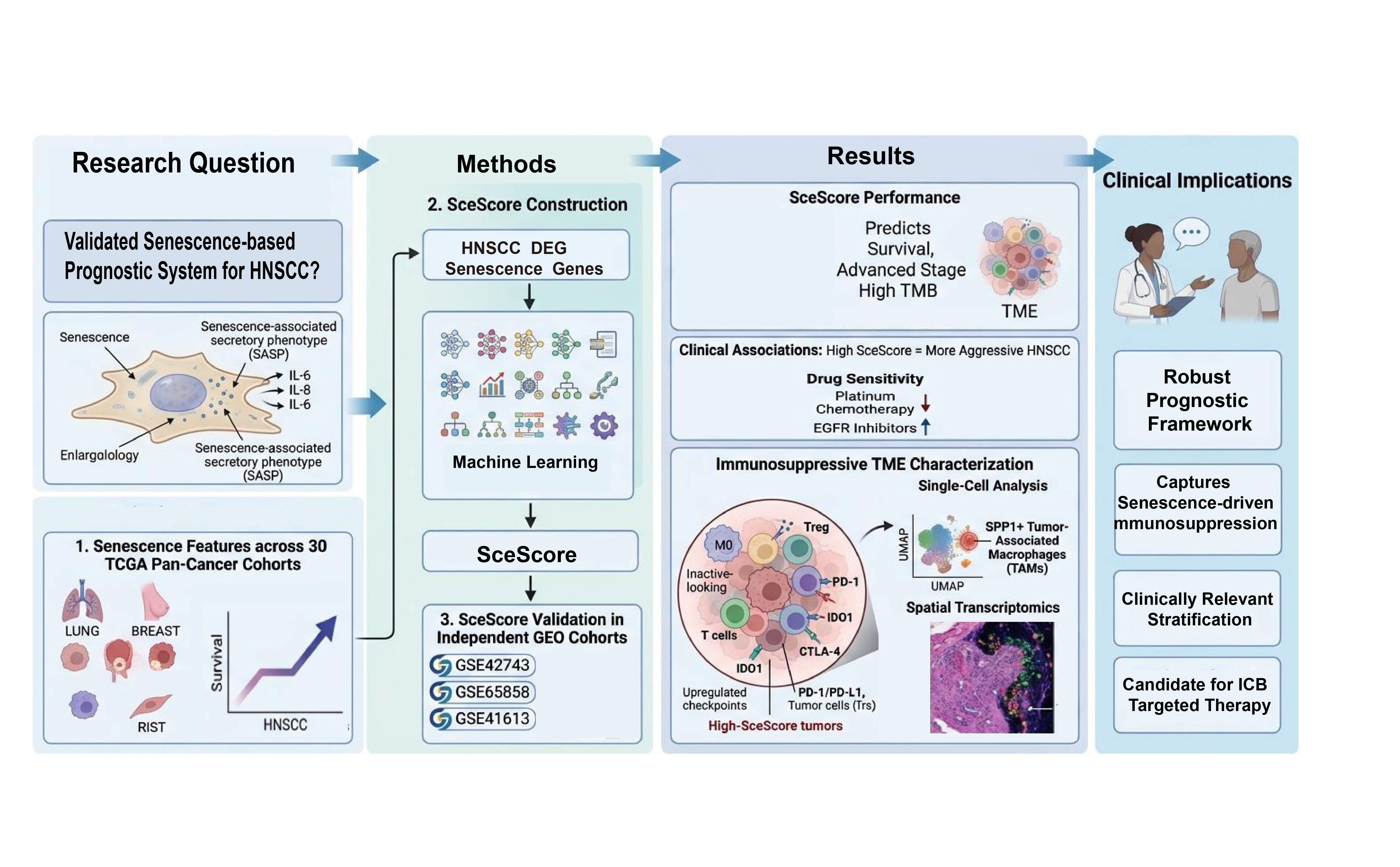
guiding therapeutic decision-making in HNSCC. Methods: Seven senescence- and metabolism-related gene sets were
evaluated across 30 TCGA pan-cancer cohorts. Differentially expressed
senescence genes in HNSCC were integrated using 101 machine learning algorithm
combinations under a leave-one-out cross-validation (LOOCV) framework to
construct SceScore. Prognostic performance was validated in three independent
GEO cohorts (GSE42743, GSE65858, GSE41613). Associations with immune
infiltration, drug sensitivity and tumor mutational burden (TMB) were systematically
assessed. Single-cell and spatial transcriptomic datasets were analyzed to
validate cellular origins and the spatial distribution of SceScore. Results: Senescence features showed the
strongest pan-cancer association with survival and immune phenotypes. An
eight-gene SceScore independently predicted overall survival across all HNSCC
cohorts. High SceScore correlated with advanced stage, elevated TMB and an
immunosuppressive microenvironment enriched for M0 macrophages and regulatory T
cells, with upregulated PD-1/PD-L1, CTLA-4 and IDO1 expression. High-SceScore
tumors exhibited reduced sensitivity to platinum-based chemotherapy but greater
sensitivity to EGFR inhibitors. Single-cell analysis identified SPP1+
tumor-associated macrophages as the primary drivers of high SceScore and
spatial transcriptomics confirmed their preferential enrichment at the
tumor–stroma invasive front. Conclusion:
SceScore is a robust, independently validated prognostic tool that captures
senescence-driven immunosuppression in HNSCC, offering a clinically actionable
framework for risk stratification and therapeutic decision-making, including
guidance for ICB and targeted therapy selection.
Keywords
Cellular senescence
Head and neck squamous cell carcinoma
Immune checkpoint
Machine learning
Prognostic biomarker
Single-cell RNA sequencing
Spatial transcriptomics
Tumor microenvironment