original articles
Targeting ICAM1- driven immune dysfunction in
ulcerative colitis: Integrative evidence from in-vivo and in-silico
studies
Sana Rashid, Sara Zahid, Sampath Chinnam, Maria Fareed, Muhammad Kashif
Available Online Date: 08 Nov 2026
Abstract
Abstract: Background: Ulcerative
colitis is chronic inflammatory bowel disease defined by aberrant immune
response and recurrent intestinal mucosal inflammation. Anti-inflammatory and
antioxidant sesquiterpene alpha-cubebene is thought to ameliorate UC
pathogenesis via down-regulation of ICAM1 expression, inhibition of NFκB and
MAPK-mediated inflammatory pathways. Objectives: To investigate ICAM1 as a biomarker and therapeutic target for
cell adhesion and leukocyte migration, and to explore alpha-cubebene as a potential
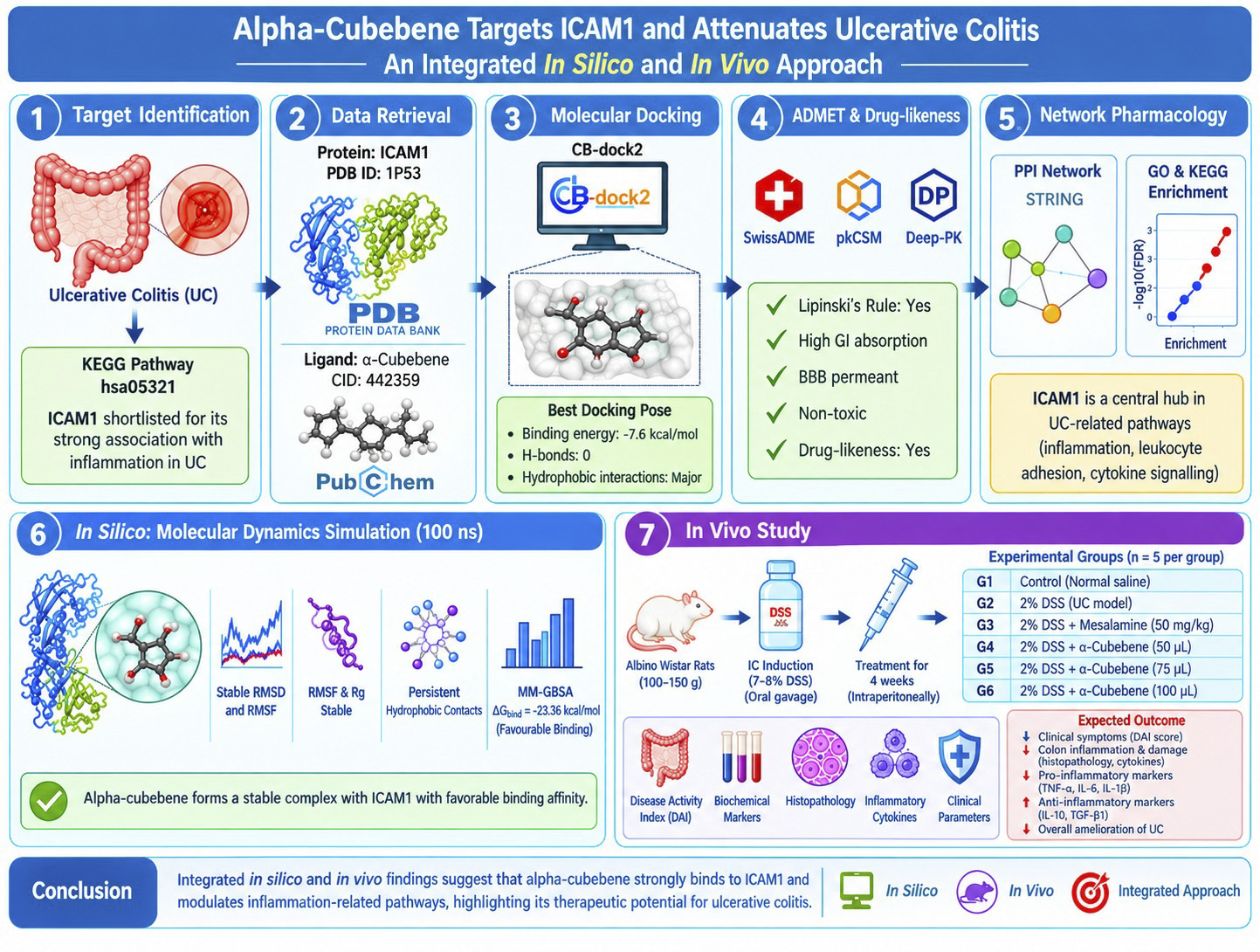
ICAM1 inhibitor for the first time. Methods: ICAM1 structure was
retrieved from RCSB PDB database and docked by CB-dock2. ADMET and drud
likeness analysis of alpha-cubebene were evaluated by SwissADME, pkCSM and
Deep-PK softwares. Stereochemistry of ICAM1 was assessed through Ramachandran
plot and hydrophobicity analysis. Protein-protein interaction was established
by STRING analysis and Gene Ontology (GO) followed by MD simulation. For in-vivo validation, Ulcerative colitis was induced in 30 male Albino Wistar rats using
2% DSS administered orally for four weeks, randomized into six groups (n =
5/group) and then treated with different concentrations of α-cubebene and
Mesalamine for one month. Therapeutic efficacy was evaluated by assessing
disease activity and experimental parameters and histopathological analysis. Results: Molecular docking and MD
simulation of ICAM1 and alpha-cubebene revealed Vina score of -6.1kcal/mol
showing it a stable protein. Network
pharmacology, protein-protein interactions, STRING and GO enrichment analysis
revealed therapeutic targeting of ICAM1 interactions can be a potential
therapeutic approach for alleviating UC. In in-vivo
studies, DSS administration significantly increased the disease activity score
compared with normal control (P = 0.001), while α-cubebene treatment
markedly and dose-dependently attenuated disease severity. The highest
α-cubebene dose (100 µL, 10 mg/kg/day) restored the disease activity score of
ICAM1 towards normal and demonstrated greater therapeutic efficacy than
Mesalamine. Histopathological results further confirmed it. Conclusion: Alpha-cubebene could serve
as an effective candidate for phytotherapy of UC via specifically affecting
inflammatory response mediated by ICAM1.
Keywords
Alpha-Cubebene
ADMET analysis
GO enrichment
ICAM1
Molecular docking
Protein-protein interaction