original articles
Identification of
cultivar-specific markers for Zhangtouhong citri reticulatae pericarpium by
integrated GC-MS, electronic nose and HPLC profiling
Liujin Wu, Jiamin Liang, Peiyang Hu, Lili Huang, Min Zhang, Meng Gao
Available Online Date: 10 Nov 2026
Abstract
Abstract: Background:
Most quality control
frameworks and aging studies on Citri Reticulatae Pericarpium (CRP) are
based on mainstream cultivars, particularly Chachi mandarin. Zhangtouhong, a
local citrus from Jiangxi Province, has received little systematic attention
regarding its cultivar-specific traits and aging-related chemical changes;
applying Chachi-derived criteria may thus bias its quality assessment. Objectives: Aging-related changes in key
constituents were compared between Zhangtouhong and Chachi CRP to identify
shared aging features, cultivar-specific traits and candidate cultivar-specific
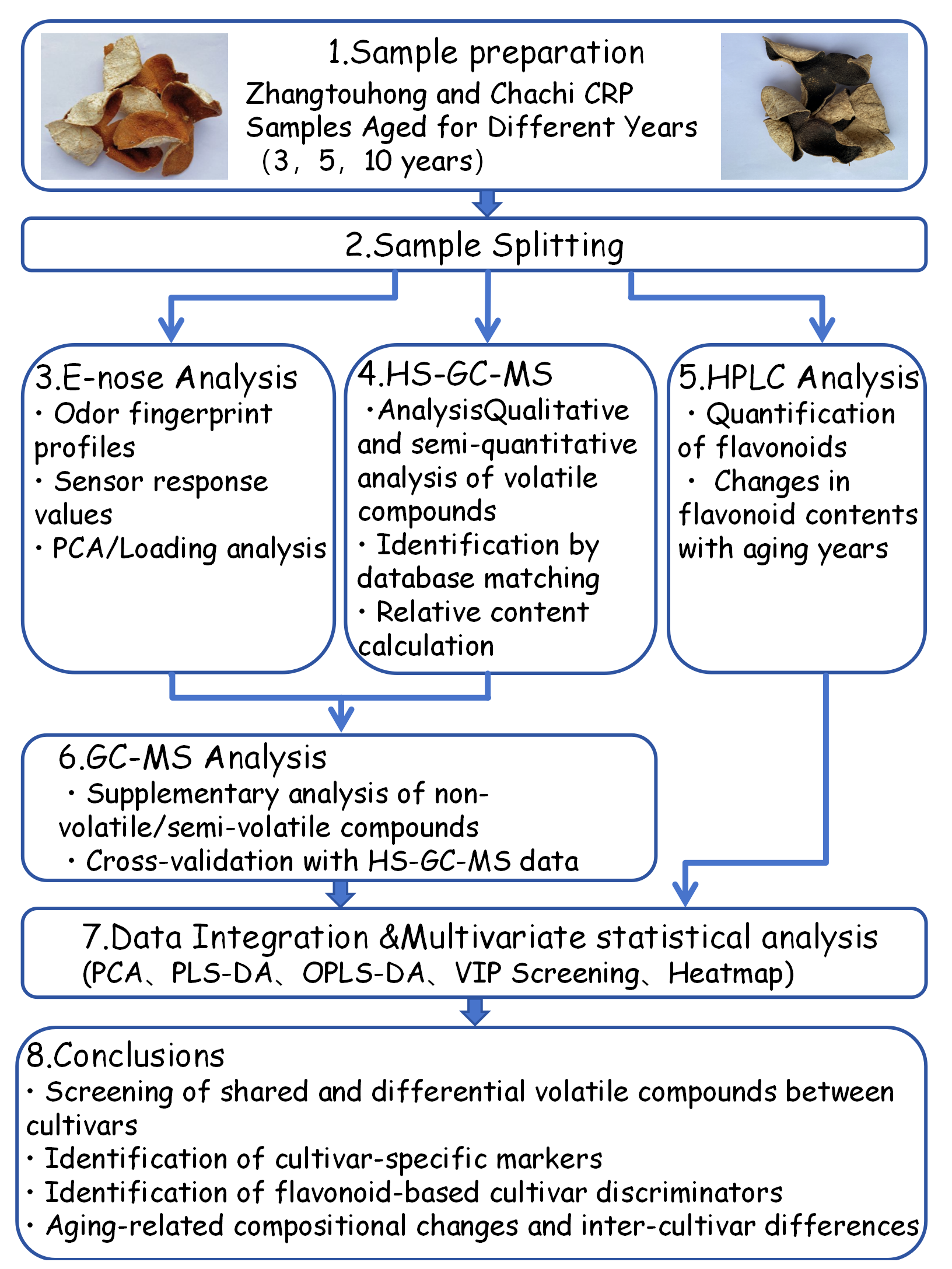
markers for Zhangtouhong quality evaluation. Methods: Samples of both cultivars aged for 3,
5 and 10 years were analyzed. Five core volatile oil components were quantified
by volatile oil determination with GC-MS; holistic odor fingerprints were
captured by electronic nose; shared volatile profiles were characterized by
HS-GC-MS; and six representative flavonoids were quantified by HPLC. Cultivar,
aging year and interaction effects were evaluated using two-factor linear
models, Spearman correlation, PCA, PLS-DA, OPLS-DA and PERMANOVA. Candidate
cultivar-specific markers were screened through an integrated multi-criteria
approach. Results:
Volatile oil yields remained relatively stable across aging, with D-limonene
dominating in both cultivars, whereas myrcene and γ-terpinene showed divergent
aging patterns. Electronic nose fingerprints clearly separated the two
cultivars, with eight sensors contributing most. HS-GC-MS identified 40 shared
volatiles, with alkenes forming the common aromatic backbone. Integrated
screening yielded 16 cultivar-specific volatile markers, among which methyl
2-(methylamino) benzoate, linalool and α-thujene were prioritized. Among
flavonoids, hesperidin was strongly associated with aging duration, while
nobiletin, 5-demethylnobiletin and sinensetin showed high discriminative power
for cultivar differentiation. Conclusion: Zhangtouhong and Chachi CRP exhibit both common
aging-related chemical changes and marked cultivar-dependent differences. CRP
quality markers should therefore be distinguished as candidate common aging
markers and cultivar-specific markers. Systems built solely on Chachi cannot
fully capture Zhangtouhong characteristics, underscoring the need for
cultivar-adapted quality evaluation methods.
Keywords
Citri reticulatae pericarpium
Cachi cultivar
Cultivar specificity
Candidate cultivar-specific markers
Zhangtouhong cultivar