original articles
Construction
of a county-town-village three-level drug distribution system in county-level
medical consortia: A palliative care opioid analgesic model from Huzhou city,
Zhejiang province, China
Hongwu Wang, Caiying Zhang, Ting Zhu
Available Online Date: 11 Nov 2026
Abstract
Abstract: Background: In county-level and rural regions of China, access
to opioid analgesics for palliative care is constrained by centralized
dispensing, fragmented drug distribution systems and limited patient mobility.
Although county-level medical consortia have strengthened healthcare
integration, an evidence-informed framework for the decentralized yet regulated
distribution of controlled medicines remains insufficiently developed.
Objectives: This study aimed
to develop and evaluate, through simulation-based policy modeling, a
County–Town–Village (CTV) three-level drug distribution framework for opioid
analgesics within county-level medical consortia using Zhejiang Province as a conceptual case study. Methods: A simulation-based comparative
policy analysis was performed using structured simulated data representing 12
modeled county-level medical consortia (six intervention and six comparison
counties) over a simulated 12-month period. Simulation inputs were generated
from plausible county-level healthcare characteristics, opioid prescribing
patterns, travel distances and pharmaceutical governance indicators.
Difference-in-differences (DiD) analysis was applied to compare projected
outcomes between simulated scenarios, including medication access time, travel
distance, continuity of opioid use, documentation completeness, adverse drug
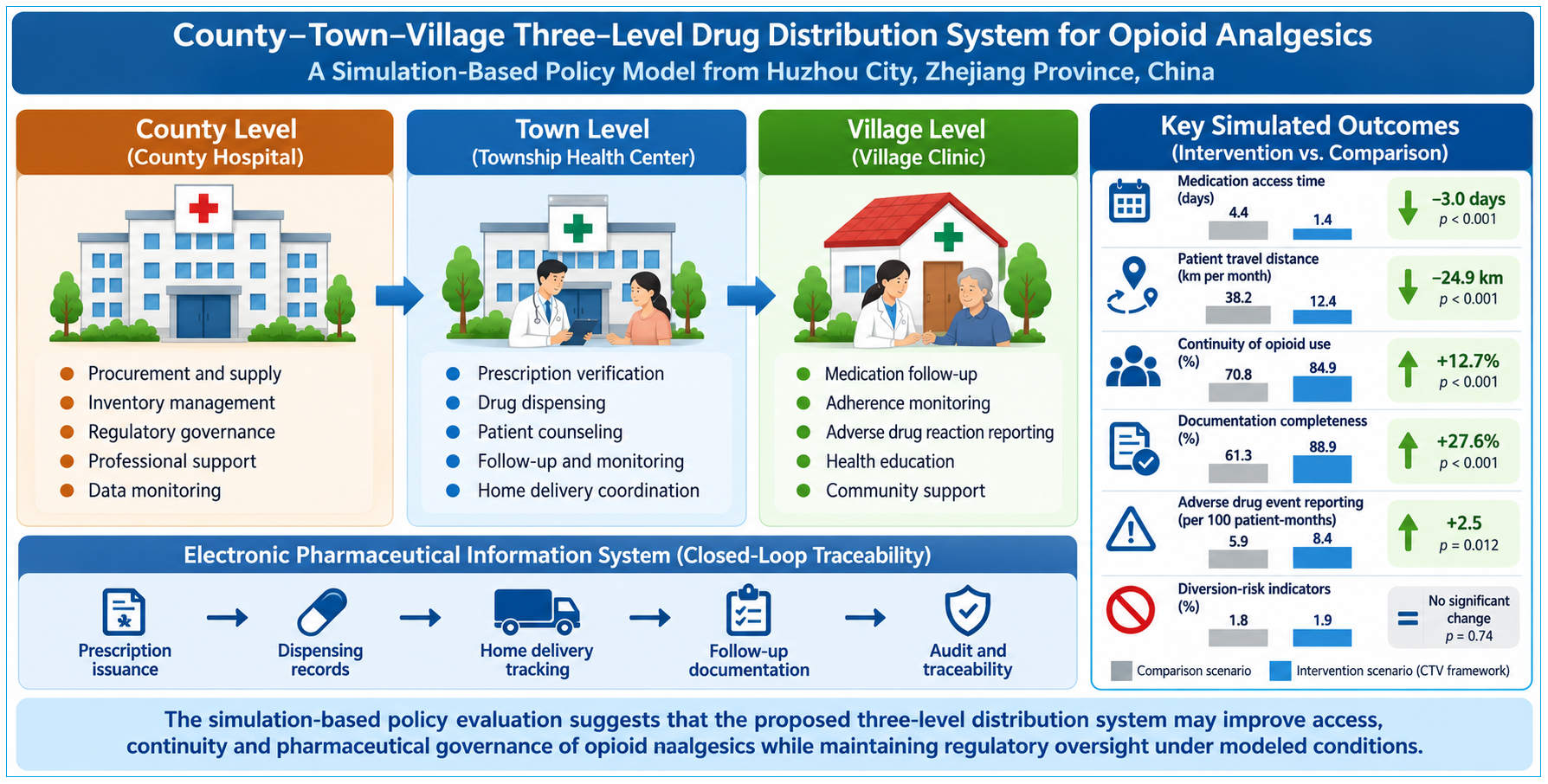
event reporting and diversion-risk indicators. Results: The modeled intervention projected
shorter medication access time (DiD = −3.0 days; p < 0.001), reduced travel
distance (DiD = −24.9 km/month; p < 0.001), improved continuity of opioid
use (70.8% to 84.9%; DiD = +12.7 percentage points; p < 0.001) and greater
documentation completeness (61.3% to 88.9%; p < 0.001). Simulated adverse
drug event reporting increased (5.9 to 8.4 per 100 patient-months; p = 0.012),
whereas diversion-risk indicators remained unchanged (1.8% vs. 1.9%; p = 0.74).
Conclusion: This
simulation-based policy evaluation suggests that the proposed three-level
distribution framework may improve access, continuity and pharmaceutical
governance of opioid analgesics while maintaining regulatory oversight under
modeled conditions. Because these findings are simulation-derived rather than
empirically observed, prospective real-world implementation studies are
required before policy adoption.
Keywords
County-level medical consortia
County–Town–Village three-level system
Opioid analgesics
Palliative care
Pharmaceutical governance
Simulation modeling