original articles
Baseline
high-frequency ultrasound thickness and doppler vascularity predict early
imaging response to intralesional corticosteroid therapy in keloids: A compound
betamethasone cohort study
Tianyi Xie, Xiaodong Chen
Available Online Date: 11 Nov 2026
Abstract
Abstract:
Background: High-frequency
ultrasound (HFUS) parameters such as scar thickness and intralesional
vascularity may reflect keloid biological activity and predict treatment
response, yet evidence supporting their baseline predictive value remains limited.
Objectives: To
evaluate whether baseline HFUS-derived thickness and Doppler vascularity can
predict early imaging response to intralesional corticosteroid therapy in
keloids and to explore their association with fibrosis-related molecular
signatures. Methods: This
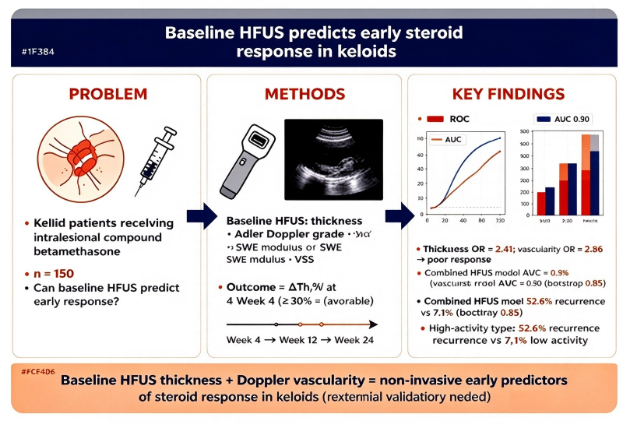
single-center prospective cohort study enrolled 150 keloid patients receiving
standardized compound betamethasone injections. Baseline HFUS measurements
included scar thickness, Adler vascularity grade and shear wave elastography
(SWE)-derived elastic modulus, along with Vancouver Scar Scale (VSS)
assessment. We defined early imaging response at week 4 as percentage thickness
reduction (ΔTh%4W). Multivariable logistic regression and receiver
operating characteristic (ROC) analysis identified predictors of poor early
response (ΔTh%4W < 30%). We analyzed an exploratory molecular
subgroup (n=40) for miR-205-5p and RUNX2 expression. Results: Baseline thickness (OR=2.41)
and Doppler vascularity independently predicted poor early response. The combined
HFUS model showed good discriminative performance (AUC=0.90). In the
exploratory molecular subgroup, Doppler-positive lesions showed lower
miR-205-5p and higher RUNX2 expression; RUNX2 correlated positively with
thickness (r=0.92). At the week-24 follow-up (n=136), the overall recurrence
rate was 20.6%, with higher rates in high-activity lesions (52.6%) than in
low-activity lesions (7.1%). Conclusion: Baseline HFUS thickness and Doppler vascularity may be
potential non-invasive predictors of early response to intralesional
corticosteroid therapy in keloids. The HFUS-based activity classification shows
clinical potential in identifying patients likely to respond poorly to
injection monotherapy, but requires external validation. The observed molecular
associations are exploratory and need further functional validation.
Keywords
Early imaging response
High-frequency ultrasound
Intralesional vascularity
Keloid scar
Personalized medicine