original articles
Efficacy and safety of
opioid analgesia with hydromorphone combined with nalbuphine in
patient-controlled intravenous analgesia following cesarean section: A
retrospective cohort study
Guangliang Ma, Gang Xu, Yanwei Wang, Xiaobin Wu, Jiaqi Chen, Lili Zhao, Dan Pei, Huiting Liu
Available Online Date: 11 Nov 2026
Abstract
Abstract: Background: Cesarean section serves as a widely
employed surgical procedure in obstetric care. Intraoperative tissue trauma and
postoperative uterine contractions are prone to cause moderate to severe acute
pain. Effective postoperative analgesia can alleviate maternal suffering and
promote physical recovery. Currently, strong opioids are widely used for
postoperative intravenous analgesia, but the efficacy and safety of single
drugs and multi-drug combinations for postoperative intravenous analgesia
remain to be explored. Objectives: This study was conducted to assess the
analgesic efficacy and safety of hydromorphone combined with nalbuphine versus
hydromorphone monotherapy in patient-controlled intravenous analgesia (PCIA)
following cesarean section, to optimize the analgesic protocol for clinical
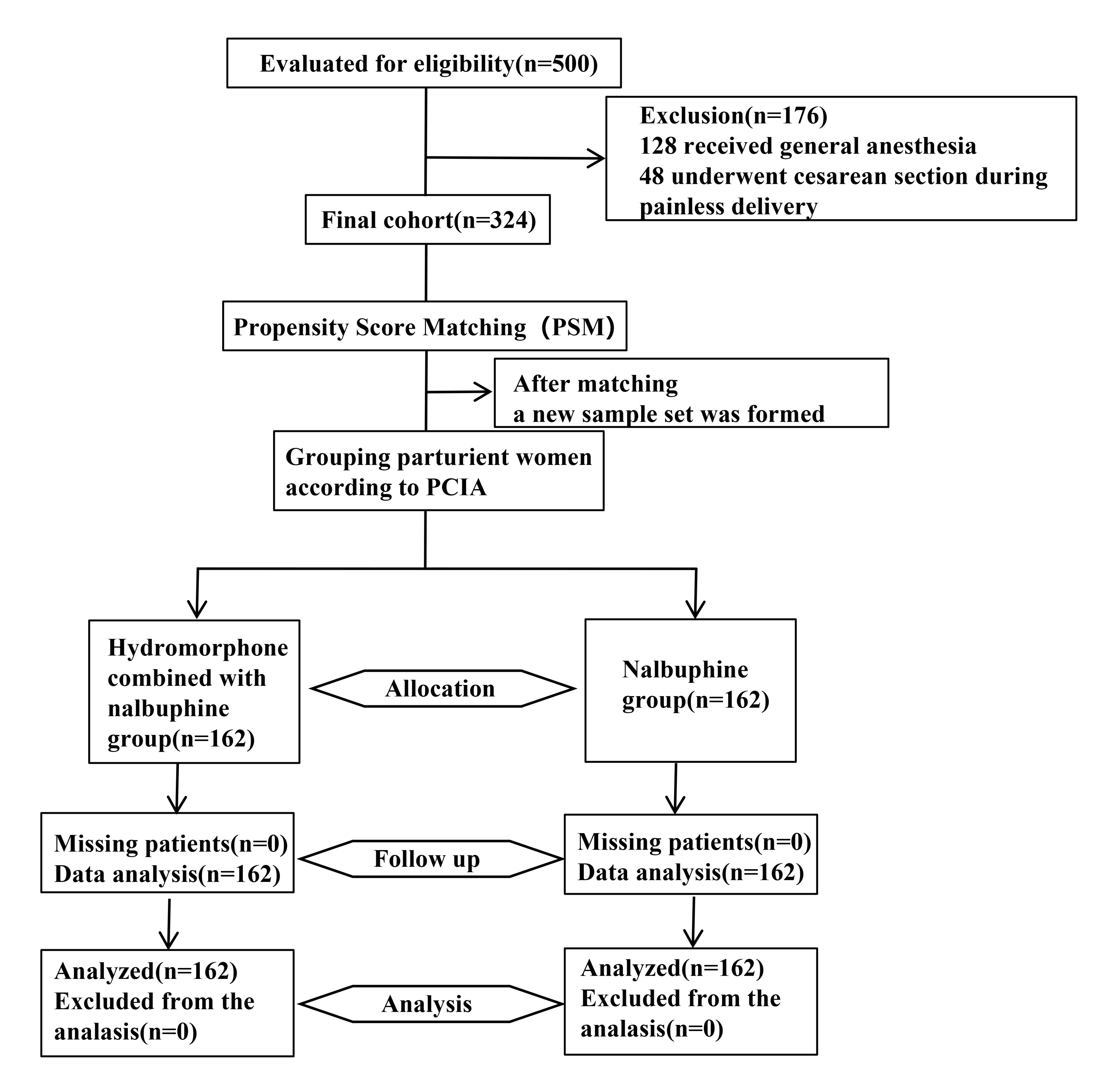
application. Methods: Based on retrospective medical records, parturients
meeting the inclusion criteria were assigned to either the combination group
(hydromorphone + nalbuphine, n=162) or the control group (hydromorphone alone,
n=162) according to their postoperative PCIA regimens. Primary and secondary
outcome indicators were compared between the two groups. Primary indicators
included Visual Analog Scale (VAS) scores at 2 h, 6 h, 12 h, 24 h and 48 h
postoperatively, as well as PCIA button-pressing times. Secondary indicators
encompassed Ramsay Sedation Scale scores at 2 h, 6 h, 12 h, 24 h and 48 h
postoperatively, the incidence of analgesia-related adverse reactions (such as
nausea, vomiting, dizziness, pruritus and respiratory depression) and patient
satisfaction levels. Results: The combination group achieved significantly
lower VAS scores than the control group at all time points (p≤0.001),
fewer PCIA presses (p<0.001)
and slightly higher Ramsay
Sedation Scale scores (p<0.05), all maintaining within 2-4 points (optimal
sedation range). The incidence of common adverse reactions was markedly
decreased (32.1% vs 50.0%, p<0.001) and the satisfaction rate was
higher (82.7% vs 65.4%, p<0.001). Conclusion: Hydromorphone combined with nalbuphine exerts
synergistic analgesic effects, with a lower incidence of adverse reactions and
higher satisfaction. This optimized regimen is safe and worthy of clinical
promotion
Keywords
Cesarean section
Hydromorphone
Nalbuphine
Postoperative analgesia
Patient-controlled intravenous analgesia (PCIA)