original articles
Oleanolic acid nanoparticle-integrated gel: A novel
topical approach for antimicrobial therapy
Amna Naz, Rouheena Shakir, Sadia Haider, Nadia Anwar, Sana Saeed, Rabia Khokhar, Habiba Rafique, Haider Ali, Huzaifa Rana, Hafiz Arfat Idrees, Sheryar Afzal, Muhammad Farooq
Available Online Date: 11 Nov 2026
Abstract
Abstract: Background:Topical oleanolic acid (OA) delivery is challenged by poor aqueous solubility and limited skin
permeation, necessitating nanoparticle-based and bioadhesive gel systems to
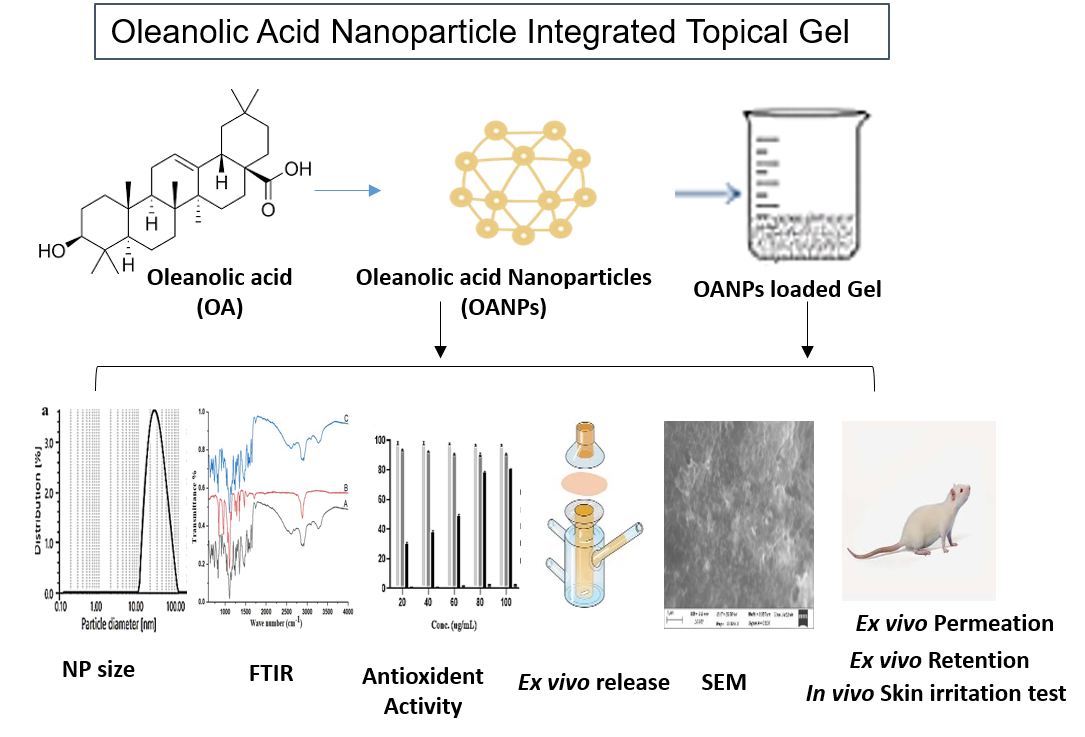
improve dermal retention. Objectives: This study aimed to develop and evaluate a
topical gel formulation incorporating oleanolic acid nanoparticles (OANPs) to
enhance the solubility and therapeutic efficacy of OA. Methods: OANPs were formulated using the nanoprecipitation
technique and assessed for various physicochemical tests, whereas comprehensive
gel assessment included physical appearance, pH, viscosity, spreadability
and in-vitro drug release. In
addition, scanning electron microscopy (SEM) analysis and an in-vivo
skin irritation test were also conducted. A comparative analysis of ex-vivo drug permeation was also
accomplished for free OA suspension, OANPs (F3) and OAG1. Results: The optimized OANPs (F3) maintained a mean
nanoparticle size of 12.81 nm, making it more suitable for dermal application.
Values of % entrapment efficiency (E.E), polydispersity index (PDI) and zeta
potential were 79.18%, 0.32 ± 0.04 and -26.2 ± 1.2 mV, respectively,
thus displaying maximum % EE, uniform size distribution and good
colloidal stability. OANPs (F3) showed strong free-radical scavenging
potential. Likewise, antimicrobial testing revealed notable zones of inhibition
(ZOI) against Escherichia coli, Pseudomonas aeruginosa and Staphylococcus
aureus, confirming the effective bioactive potential. Oleanolic acid
nanoparticle integrated gel
formulation1(OAG1) demonstrated
desirable ex-vivo drug release and
permeation up to 36 h, along with no signs of irritation, redness, or lesions
upon in-vivo skin irritation
testing. Conclusion: OANPs were optimized, and the selected
formulation (F3) was incorporated into a bioadhesive gel (OAG1) to overcome the
poor aqueous solubility and limited skin permeation of OA. Both F3 and OAG1
showed comparable ex vivo drug release and permeation; however, OAG1
significantly improved OA skin retention due to its optimized viscosity, polymeric
composition, improved antimicrobial action and bioadhesive properties
Keywords
Antibacterial
Antioxidant
Ex-vivo permeation
In-vivo skin irritation
Nanogel
OANP