original articles
Prophylactic use of
granulocyte colony-stimulating factor in breast cancer chemotherapy in china: A
retrospective observational study
Lilian Hu, Heqin Yin, Xiaohua Wang
Available Online Date: 17 Nov 2026
Abstract
Abstract: Background:
Febrile neutropenia (FN) is
a serious complication of myelosuppressive chemotherapy. Clinical practice
guidelines recommend risk-stratified prophylactic G-CSF therapy, which is
indicated primarily for patients with a high risk of febrile neutropenia (FN
>20%).Although G-CSF is widely used in clinical practice in China, it
remains unclear whether this use aligns with guideline-recommended risk
stratification, as few real-world studies have evaluated adherence. Objectives: This study aimed to evaluate
the appropriateness of prophylactic G-CSF use in hospitalized breast cancer
patients and identify the gap between clinical practice and current guidelines.
Methods: In this
single-center, retrospective observational study, we evaluated the prophylactic
use of G-CSF according to FN risk category among breast cancer patients
scheduled to receive myelosuppressive chemotherapy in hospitalized patients in
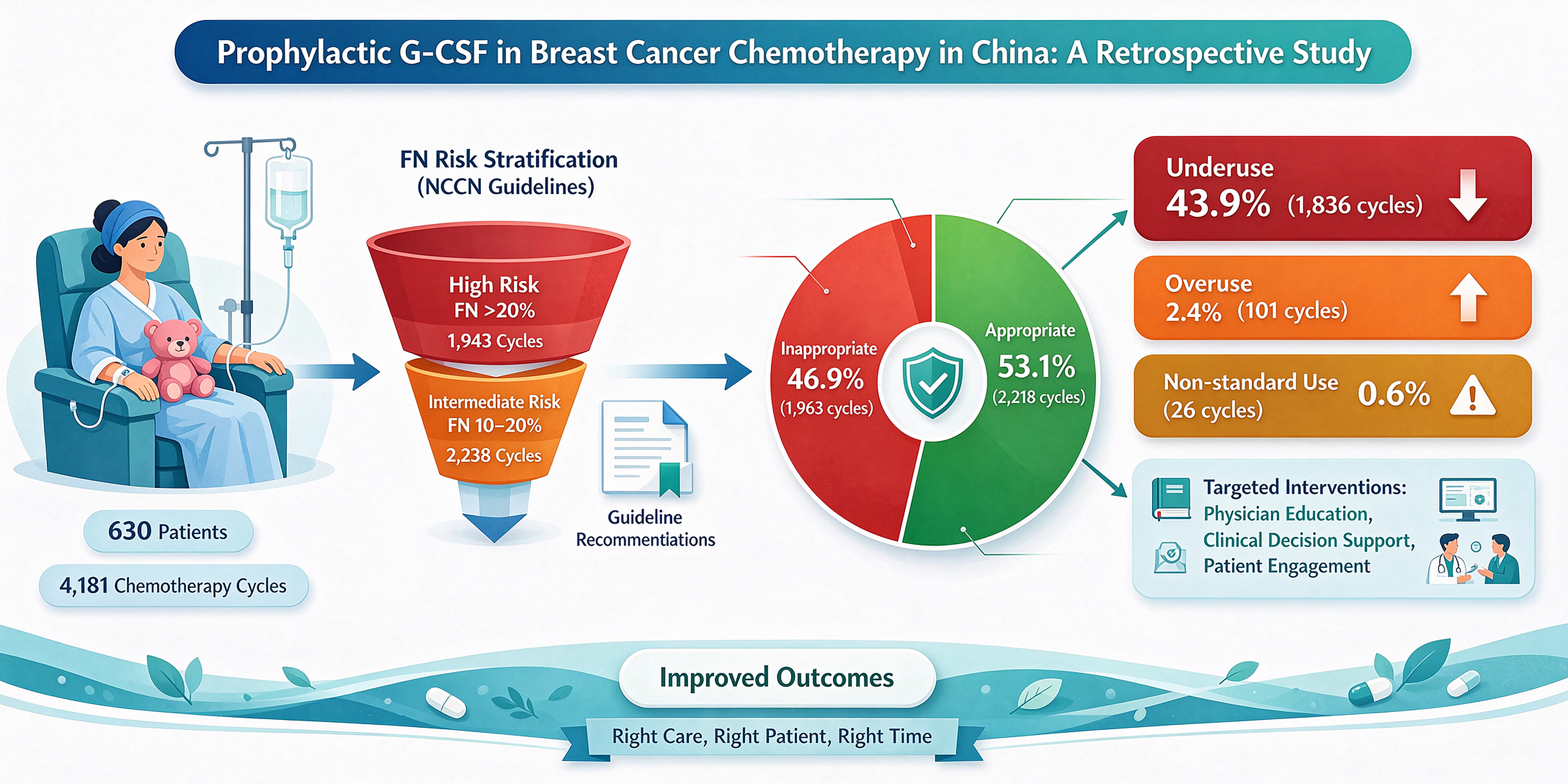
China between January 2019 and December 2021. Results: A total of 4,181 chemotherapy
cycles from 630 breast cancer patients were documented. The overall rate of
prophylactic G-CSF use was 53.1%. Among these, 1,963 cycles (46.9%) involved
inappropriate prophylactic use, including 1,836 cycles (43.9%) with underuse,
101 cycles (2.4%) with overuse and 26 cycles (0.6%) with non-standard use. Conclusion: This study reveals
substantial inappropriate use of prophylactic G-CSF in Chinese breast cancer
patients, primarily characterized by underuse in guideline-indicated scenarios.
Keywords
Breast neoplasms
Drug therapy
Granulocyte colony-stimulating factor
Febrile neutropenia