original articles
Effect of early
administration of sacubitril/valsartan in ST-elevation myocardial infarction
patients undergoing PCI: Impact on infarct size and ventricular remodeling
Lei Sun, Haibin Jin, Xiaoqin Wen, Xingyu Huo
Available Online Date: 18 Nov 2026
Abstract
Abstract: Background: Adverse left ventricular remodeling remains a
major determinant of heart failure and mortality in patients with ST-elevation
myocardial infarction (STEMI) despite successful primary percutaneous coronary
intervention (PCI). Sacubitril/valsartan has shown beneficial effects on
ventricular remodeling in heart failure populations; however, evidence
regarding its early initiation following STEMI remains limited. Objectives: To
evaluate the association of early sacubitril/valsartan initiation with
infarct-size markers and ventricular remodeling outcomes in STEMI patients
undergoing primary PCI. Methods:
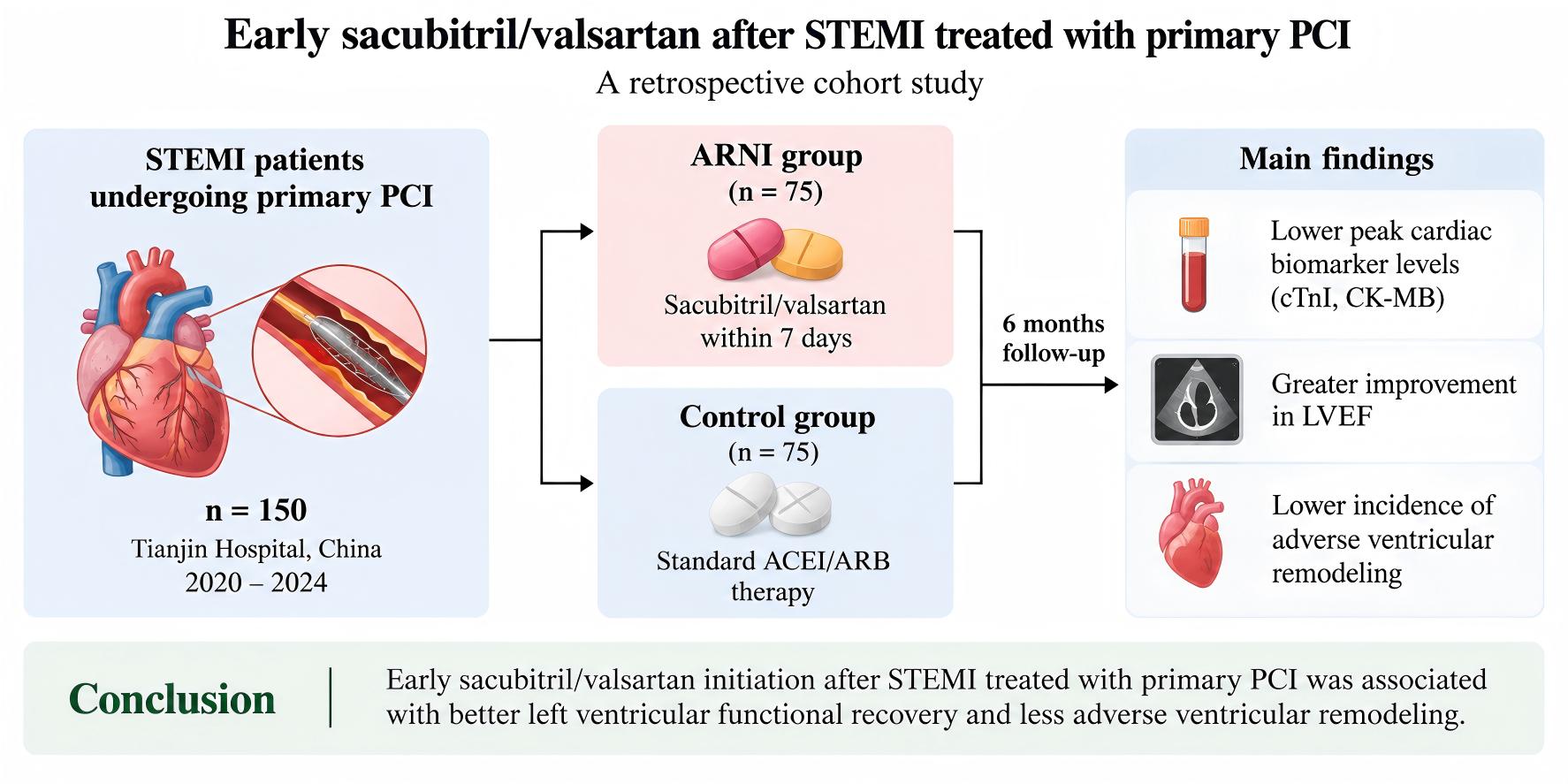
This retrospective observational cohort study included 150
consecutive STEMI patients treated with primary PCI at Tianjin Hospital, China,
between January 2020 and December 2024. Patients were categorized into an
angiotensin receptor–neprilysin inhibitor (ARNI) group receiving
sacubitril/valsartan within 7 days of STEMI or a control group receiving
standard ACEI/ARB therapy. Ventricular remodeling was assessed using serial
echocardiographic measurements including left ventricular ejection fraction
(LVEF), left ventricular end-diastolic volume (LVEDV) and left ventricular
end-systolic volume (LVESV). Clinical outcomes were evaluated with a minimum
follow-up of 6 months. Results:
Baseline demographic and procedural characteristics were comparable
between groups. Patients receiving early sacubitril/valsartan demonstrated
lower peak cardiac biomarker levels and greater improvement in follow-up LVEF
compared with the control group. Adverse ventricular remodeling occurred less
frequently in the ARNI group. Heart failure–related hospitalizations were lower
among patients receiving sacubitril/valsartan, whereas all-cause mortality and
adverse event rates were comparable between groups. Multivariable analysis demonstrated
that early sacubitril/valsartan initiation was associated with favorable
ventricular remodeling. Conclusion: Early sacubitril/valsartan initiation after STEMI treated
with primary PCI was associated with improved ventricular remodeling and better
recovery of left ventricular systolic function in this retrospective cohort.
These findings should be considered hypothesis-generating and require
confirmation in larger prospective randomized studies.
Keywords
Angiotensin receptor–neprilysin inhibitors
Infarct size
Left ventricular ejection fraction
Primary percutaneous coronary intervention
Sacubitril/valsartan
ST-elevation myocardial infarction
Ventricular remodeling