original articles
Induction-maintenance
intravesical gemcitabine after transurethral resection for intermediate- and
selected high-risk non-muscle-invasive bladder cancer: A propensity
score-matched cohort study
Junqing Gu, Chunmei Wang, Chunlin Tan, Dan Lv, Jing Huang, Yugen Li
Available Online Date: 19 Nov 2026
Abstract
Abstract: Background:
Conventional intravesical
chemotherapeutic agents for non-muscle-invasive bladder cancer (NMIBC) are
limited by drug resistance and local adverse reactions, which may restrict
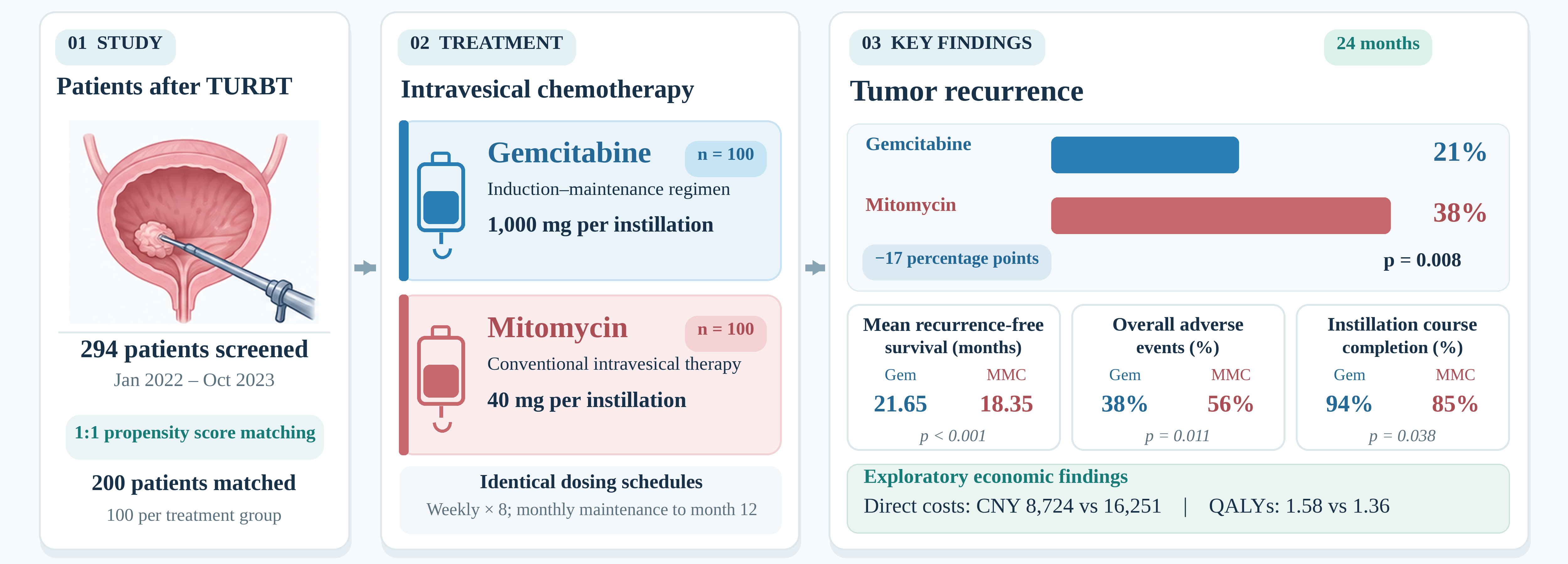
their clinical benefit. Objectives: This study aimed to evaluate the clinical efficacy,
urinary and serum concentration indicators, safety and exploratory
pharmacoeconomic value of induction-maintenance intravesical gemcitabine as
postoperative adjuvant therapy for intermediate- and selected high-risk NMIBC. Methods: A retrospective propensity
score-matched cohort design was used. A total of 294 patients with
intermediate- and selected high-risk NMIBC who underwent transurethral
resection of bladder tumor from January 2022 to October 2023 were screened and
follow-up records were reviewed through 31 October 2025. After 1:1
nearest-neighbor matching, 100 patients were retained in the
induction-maintenance intravesical gemcitabine group and 100 in the
conventional intravesical mitomycin group; tumor recurrence, recurrence-free
survival, urinary and serum concentration indicators, adverse events and direct
medical costs were compared between the two groups. Results: The tumor recurrence rates at
12 and 24 months were lower in the gemcitabine group than in the mitomycin
group (p=0.008) and the mean recurrence-free survival time was longer in the
gemcitabine group (p<0.001). The overall incidence of adverse events was
lower in the gemcitabine group than in the mitomycin group (p=0.011) and the
completion rate of the instillation course was higher in the gemcitabine group
(p=0.038). The gemcitabine group showed lower 24-month direct medical costs and
higher QALYs, indicating a dominant cost-saving pattern in this exploratory
economic analysis. Conclusion:
Induction-maintenance intravesical gemcitabine was associated with
lower recurrence and better treatment completion than mitomycin in this matched
cohort, but the study was not designed to compare gemcitabine with Bacillus
Calmette-Guérin and should not be interpreted as establishing superiority or
non-inferiority to BCG in high-risk NMIBC.
Keywords
Clinical efficacy
Gemcitabine
Intravesical instillation
Non-muscle-invasive bladder cancer
Pharmacoeconomics