original articles
Synthesis, characterization and biological
evaluation of chromone-salicylhydrazide hybrid molecules
Sidra Rafique, Noor ul Amin Mohsin
Available Online Date: 21 Nov 2026
Abstract
Abstract: Background: Chromone and
salicylhydrazide are important scaffolds with multiple biological activities.
The molecular hybridization of these scaffolds may lead to the synthesis of new
molecules with enhanced pharmacological activities and better drug-like
properties. Studies on chromone-salicylhydrazide hybrids combined with
antioxidant, anti-inflammatory, cytotoxic potential and drug-like properties
evaluations are limited. Objectives:
The study aimed to synthesize, characterize and evaluate the biological
potential of chromone-salicylhydrazide-hybrid molecule as anti-inflammatory,
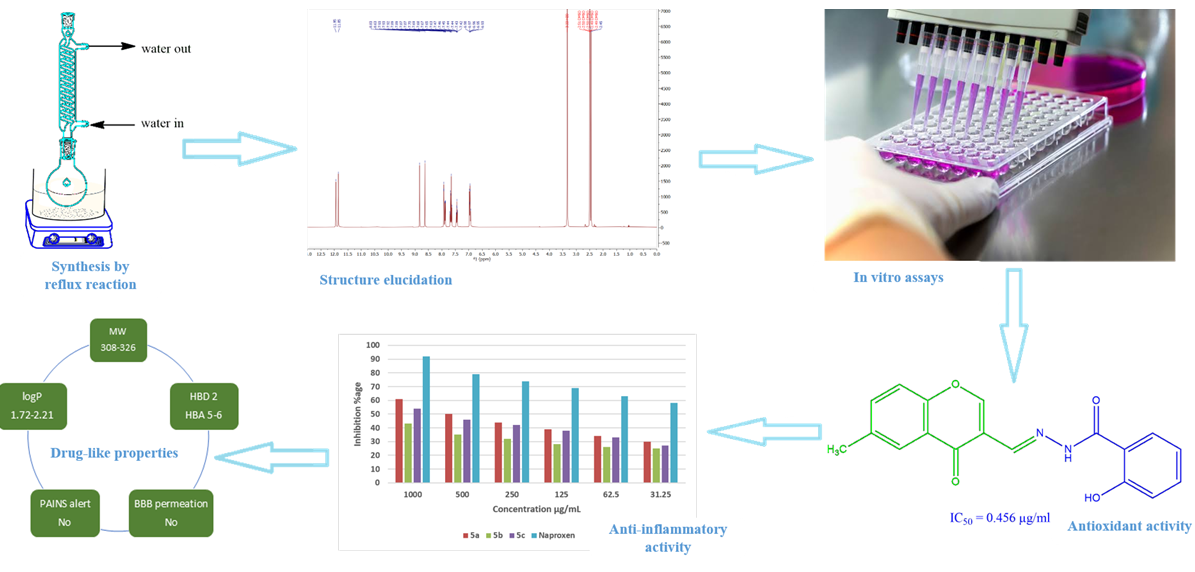
antioxidant, cytotoxic and in-silico drug-like properties. Methods: The chemical synthesis was
performed in two steps. In the first step, salicylhydrazide was synthesized
from methyl salicylate. In the second step, salicylhydrazide was reacted with
chromones to produce the hybrid molecules 5a-5c. Compounds 5a-5c were
characterized by using the Fourier transform infrared spectroscopy (FTIR), Proton
nuclear magnetic resonance spectroscopy (1H-NMR), Carbon -13 nuclear
magnetic resonance spectroscopy (13C-NMR) and mass spectroscopic
(MS) techniques. Derivatives 5a-5c were evaluated for in-vitro antioxidant, anti-inflammatory and cytotoxic potential.
The drug-like characteristics were assessed by in-silico analysis. Results:
Chromone-salicylhydrazide molecules exhibited promising biological activity.
Compound 5b (IC50 = 0.546
µg/mL) presented excellent
antioxidant activity. Compound 5a (59-61%
inhibition) exhibited excellent
anti-inflammatory potential. The
cytotoxic study against the normal cell line (3T3) showed less toxicity (31-47%
inhibition). Compounds 5a-5c presented drug like properties by complying the
Lipinski and Veber rules. Conclusion:
Chromone-salicylhydrazide molecules manifested excellent antioxidant and
anti-inflammatory potential with low toxicity toward the normal cell line along
with suitable drug-like properties. Therefore, they are promising biologically
active agents for further investigations.
Keywords
Characterization
Drug-likeness
Hybridization
In-vitro evaluation
Synthesis