original articles
Adaptive titration of renin–angiotensin–aldosterone system inhibitors in
elderly HFpEF patients with hypertension: A retrospective cohort study of
short-term effectiveness and tolerability
Qi Wu, Lina Chen, Danlei Wang, Huihui Xia, Suling Di, Xifan Zhou, Meili Ji
Available Online Date: 21 Nov 2026
Abstract
Abstract: Background: Elderly patients with heart
failure with preserved ejection fraction (HFpEF) and hypertension (HTN) may
have poor tolerability to non-titrated fixed-dose renin-angiotensin-aldosterone
system inhibitor (RAASi) therapy, with changes in renal function or electrolyte
balance. Objectives: To evaluate whether a dynamic,
protocol-guided RAASi titration strategy was associated with better short-term
effectiveness and tolerability than a non-titrated fixed-dose regimen in
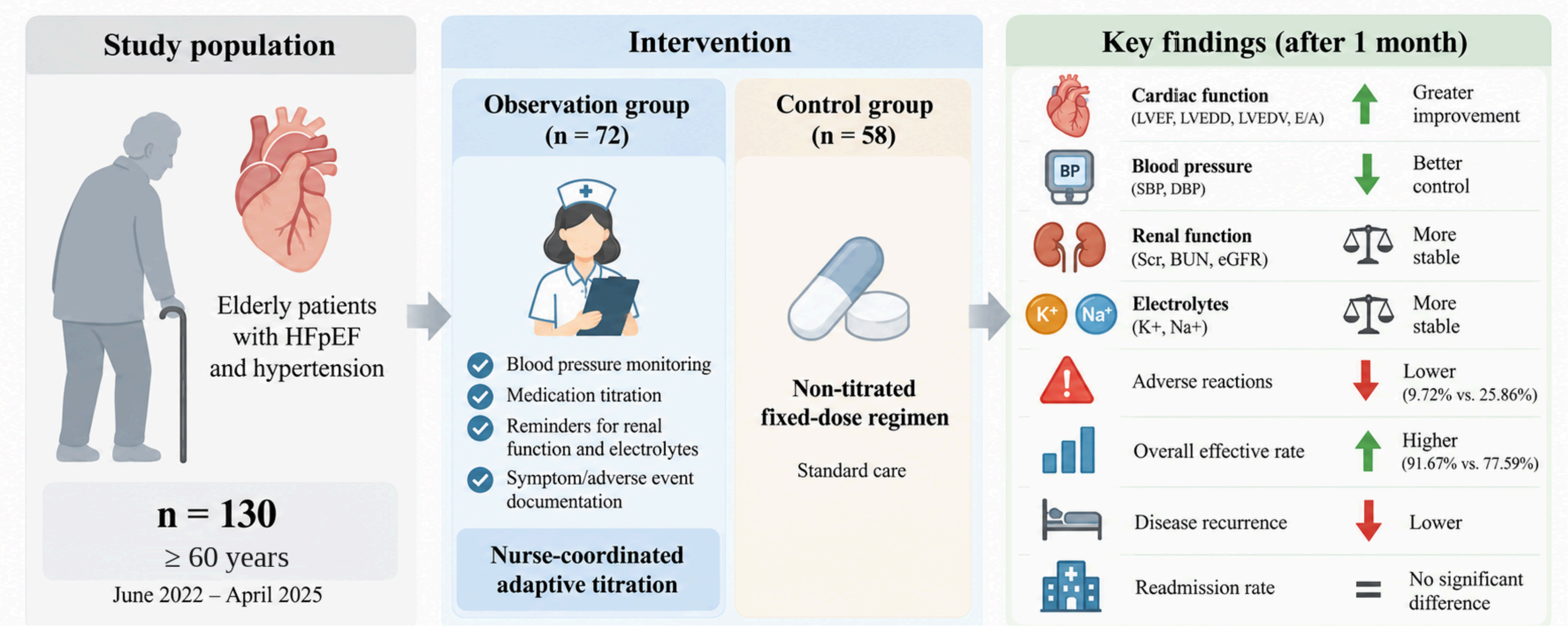
elderly patients with HFpEF and HTN. Methods: This retrospective study included 130
elderly patients with HFpEF and HTN admitted between June 2022 and April 2025.
Patients were categorized into an observation group (dynamic adaptive
management, n=72) or a control group (non-titrated fixed-dose regimen, n=58)
based on routine clinical practice. Both groups received standard symptomatic
treatment. In the observation group, adaptive titration was supported by
routine nursing monitoring, including blood pressure observation, medication
education, reminders for renal-function and electrolyte testing and
documentation of symptoms or adverse reactions. Cardiac function, blood
pressure, renal function, electrolyte indices, adverse reactions, clinical
effectiveness, medication adherence, and follow-up outcomes were compared after
1 month. Results: After 1 month, the observation group showed greater
improvement in cardiac function and blood pressure control than the control
group. Renal function and electrolyte indices remained more stable in the
observation group. Adverse reactions were less frequent in the observation
group than in the control group (9.72% vs. 25.86%), whereas the overall
effective rate was higher (91.67% vs. 77.59%) (p<0.05). Medication adherence was better and
disease recurrence was lower in the observation group (p<0.05), while
readmission rates did not differ significantly (p>0.05). Conclusion: In elderly
patients with HFpEF and HTN, a dynamic adaptive RAASi management strategy was
associated with better short-term effectiveness and tolerability than a
non-titrated fixed-dose regimen. Given the retrospective single-center design
and short follow-up, these findings should be considered preliminary and
require confirmation in larger prospective studies.
Keywords
Adaptive titration
Elderly patients
HFpEF
Hypertension
Medication safety
RAAS inhibitors