reviews
Berberine in traditional
Chinese medicine: Modulating gut microbiota for gout management - mechanisms
and clinical perspectives
Guoming Wang, Yanmei Wu, Qing Qi, Jing Yu, Mingli Gao, Tianye Deng, Pengyuan Sun
Available Online Date: 21 Nov 2026
Abstract
Abstract: Gout, a metabolic inflammatory arthritis driven
by hyperuricemia, has rising global prevalence linked to high-purine and
high-fructose diets. Gut dysbiosis, characterized by depleted beneficial
microbes and overgrown pathogenic strains, disrupts uric acid (UA) excretion
and exacerbates systemic inflammation, serving as a core pathological driver of
gout. Conventional Western anti-gout drugs only relieve transient symptoms and
carry severe side effects, whereas berberine (BBR), a bioactive alkaloid from
traditional Chinese medicine (TCM), exerts multi-target anti-gout activity via
gut microbiota regulation; however, its integrated intestinal mechanisms remain
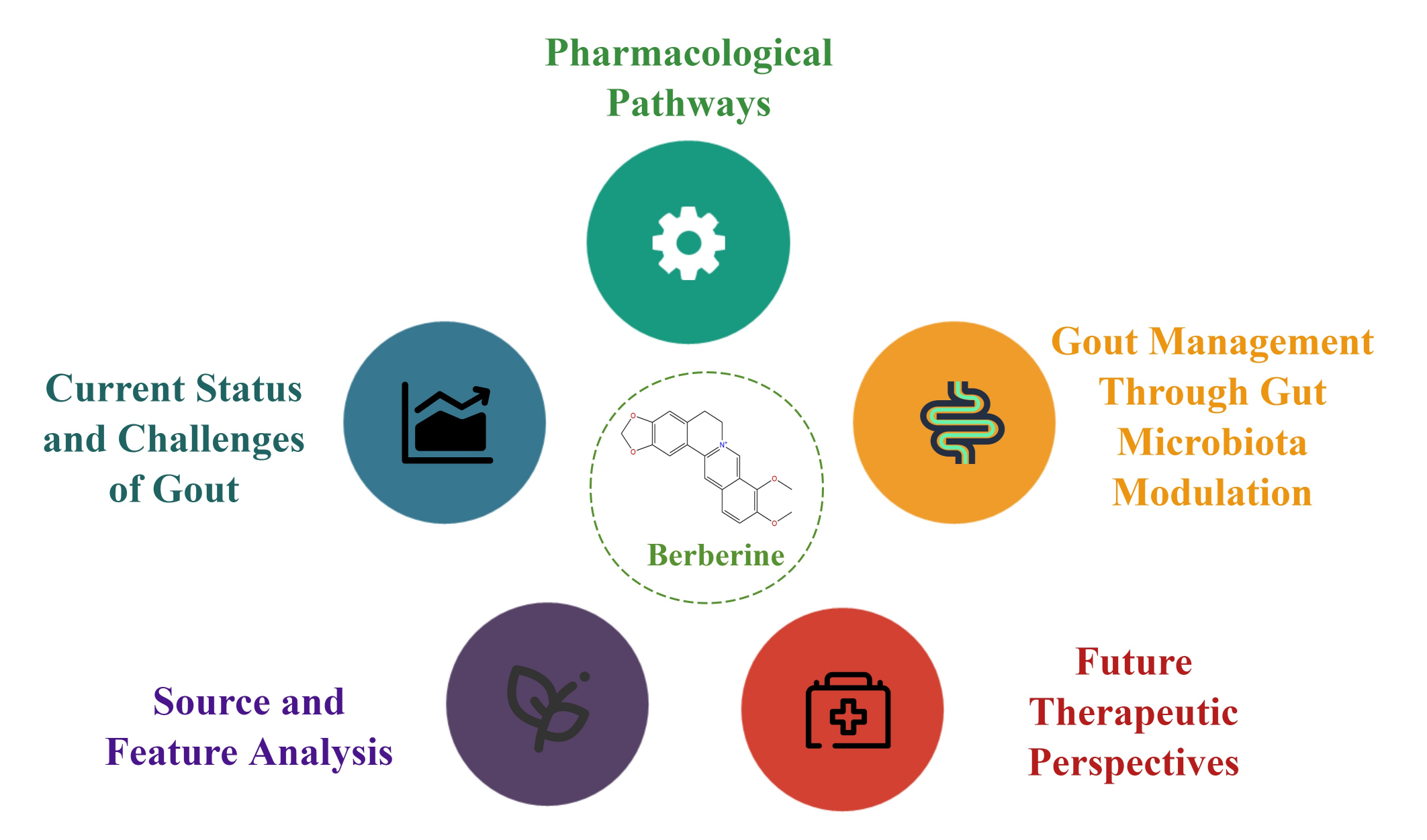
unsystematically summarized. This review elucidates the multi-pathway
mechanisms through which BBR ameliorates gout by remodeling gut microbiota
homeostasis and discusses its clinical translational prospects for gout
management. This review retrieved English (PubMed, Web of Science, Scopus,
EMBASE) and Chinese (CNKI, Wanfang) databases for peer-reviewed in vitro, animal and clinical studies
published up to December 2024, combining gut microbiota, UA metabolism and
berberine-related keywords; case reports, abstracts and duplicate papers were
excluded. BBR restores intestinal microecology by elevating beneficial bacteria
(Lactobacillus, Akkermansia, Bifidobacterium) and
suppressing pro-inflammatory pathogens. It boosts butyrate production,
upregulates intestinal ABCG2 to accelerate UA fecal excretion, and directly
inhibits xanthine oxidase to reduce UA synthesis. Gut microbiota biotransforms
BBR into DHB, OBR and other derivatives with higher bioavailability; these metabolites
further inhibit renal UA reabsorption and block NLRP3 inflammasome activation
to lower IL-1β/IL-18. The bidirectional BBR-microbiota interaction creates a
positive feedback loop that amplifies hypouricemic and anti-inflammatory
effects. BBR achieves comprehensive gout intervention via gut
microbiota-centered multi-target regulation, representing a promising
TCM-derived therapeutic strategy. Restricted oral bioavailability and
insufficient large-scale human clinical data currently limit its clinical
application; novel delivery systems, probiotic combination therapy and
long-term clinical trials are required to advance its translational use in gout
treatment.
Keywords
Berberine
Gout
Gut microbiota
Traditional Chinese medicine
Uric acid metabolism