original articles
Calcifediol ameliorates
DNCB-induced atopic dermatitis-like skin inflammation in mice with restoration
of tight junction-associated Claudin expression
Qundan Wu, Qian Ling, Shaomei Lin, Yuanzhi Hong, Cuiping Huang, Huidan Zheng, Wanting Liao, Mingzhu Chen
Available Online Date: 22 Nov 2026
Abstract
Abstract: Background:
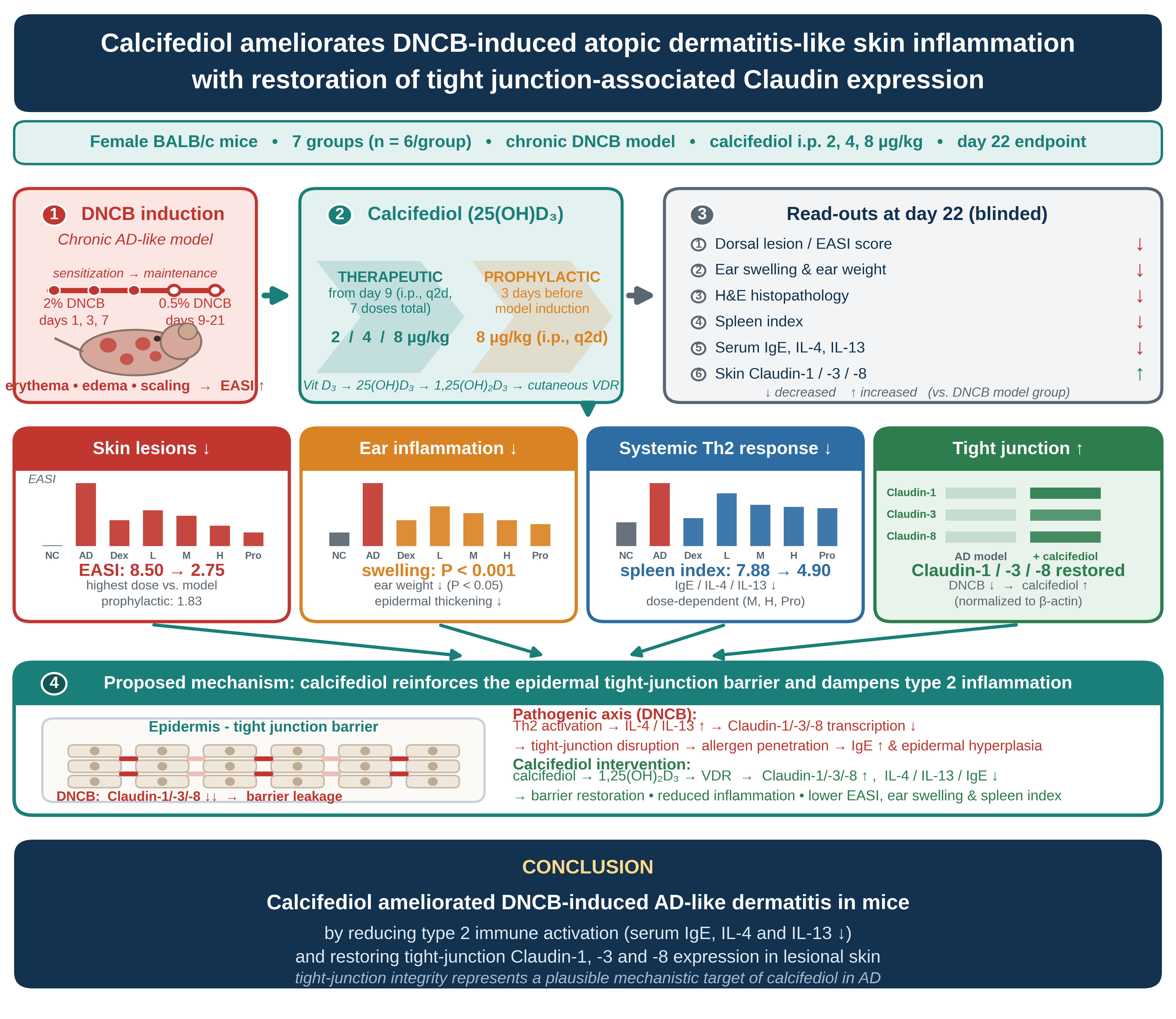
Atopic dermatitis (AD) is a
chronic, relapsing skin disease driven by epidermal barrier dysfunction and a
dominant type 2 immune profile. Calcifediol (25-hydroxyvitamin D3), the major
circulating vitamin D metabolite, has shown immunomodulatory potential in
AD-like models; however, whether its benefits extend to regulating tight
junction-associated claudin proteins, key determinants of epidermal barrier
competence in AD, remains unclear. Objectives: To evaluate the therapeutic and preventive effects of
calcifediol in a DNCB-induced chronic AD-like mouse model and determine whether
these effects are associated with the restoration of tight junction proteins
(Claudin-1, 3 and 8) expression in lesional skin. Methods: Female BALB/c mice were assigned to
seven groups: Normal control, DNCB model, dexamethasone, low-dose calcifediol,
medium-dose calcifediol, high-dose calcifediol and prophylactic calcifediol
groups. AD-like lesions were established by repeated topical application of
DNCB and calcifediol was administered intraperitoneally at 2, 4 and 8 µg/kg. Disease
severity was assessed by dorsal lesion scoring, ear swelling, ear weight,
spleen index, histopathology, serum IgE, IL-4 and IL-13 levels and cutaneous
Claudin protein expression. Results: DNCB application produced
AD-like skin inflammation, as shown by erythema, edema, scaling, epidermal
thickening, inflammatory infiltration, increased ear swelling, a higher spleen
index and elevated serum IgE, IL-4 and IL-13 levels. Calcifediol administration
reduced lesion severity, lowered EASI scores, relieved ear inflammation and
improved histopathological changes in the skin. It also decreased the spleen
index and suppressed serum IgE, IL-4 and IL-13 levels. Moreover, calcifediol
reversed the DNCB-induced reduction in Claudin-1, Claudin-3 and Claudin-8
levels in dorsal skin tissues. Conclusion: Calcifediol mitigated DNCB-induced AD-like inflammation
in mice, possibly by attenuating type 2 immune activation and restoring the
expression of tight junction-associated Claudin proteins. These results suggest
that calcifediol deserves further investigation as a potential supportive
strategy for atopic dermatitis.
Keywords
Atopic dermatitis
Calcifediol
Claudin
DNCB
Skin barrier