original articles
UHPLC–MS-based characterization of the pharmacokinetics and in-vivo
metabolic profile of oleanonic acid in rats
Ruiqi Wang, Xiaoman Lou, Nigare Abuduwaili, Yongqiang Liu
Available Online Date: 23 Nov 2026
Abstract
Abstract: Background: Oleanonic acid (ONA),
a pentacyclic triterpenoid with significant hypoglycemic and neuroprotective
activities, shows promise as a multi-target anti-diabetic candidate. However,
its pharmacokinetic behavior and metabolic fate in-vivo remain
incompletely characterized, limiting dose optimization and clinical
translation. Objective: To
investigate the pharmacokinetic profile, absolute bioavailability and metabolic
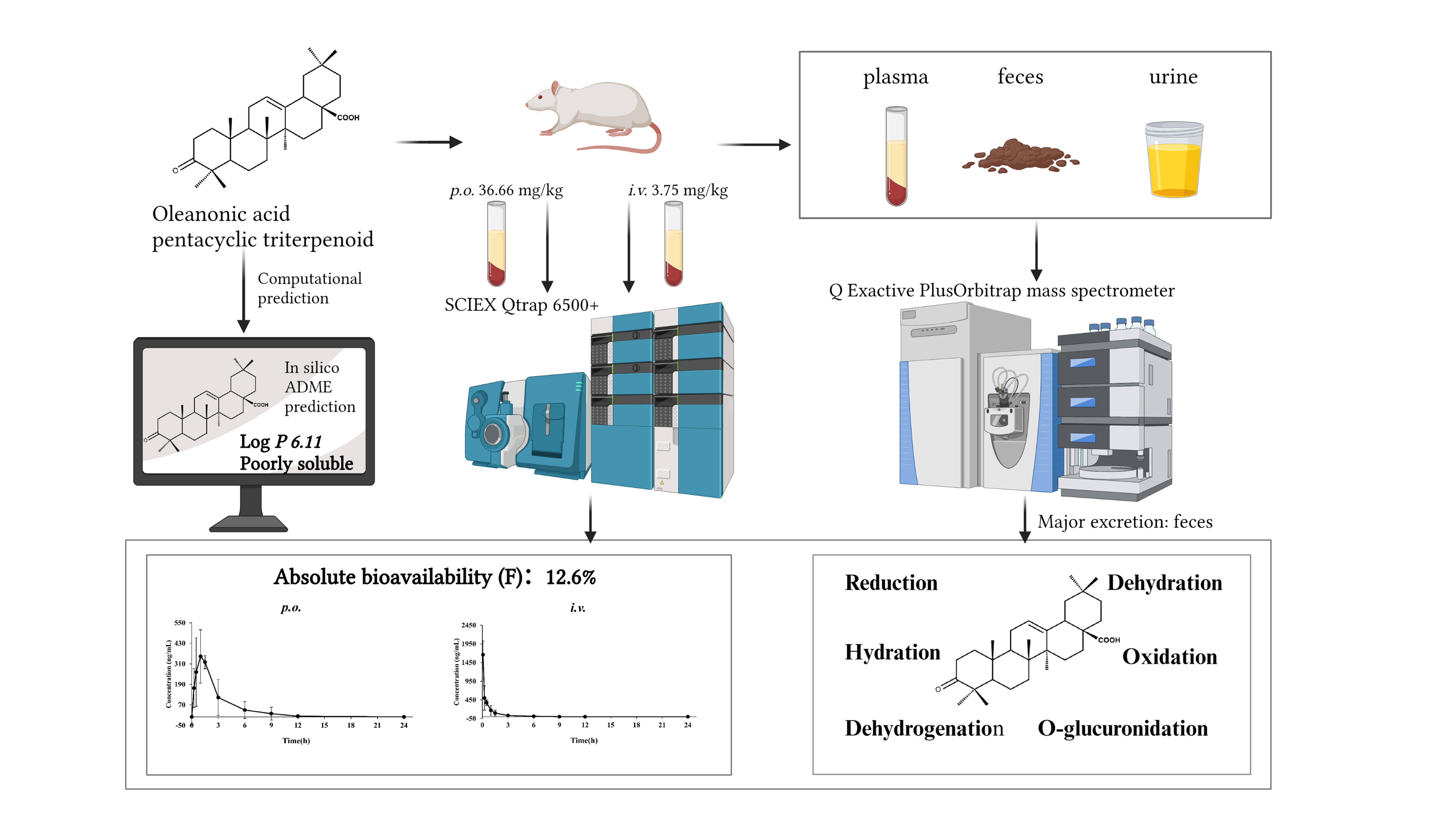
pathways of ONA in rats following oral and intravenous administration. Methods: In-silico ADME predictions
(SwissADME, GLORYx) were initially performed to guide the experimental design. Healthy
male Sprague-Dawley (SD) rats were administered ONA either orally (36.66 mg/kg)
or intravenously (3.75 mg/kg). A validated UHPLC–MS/MS
method was utilized for pharmacokinetic quantification, while UHPLC–Q–Exactive
Orbitrap HRMS was employed for comprehensive metabolite profiling in biological
matrices. Results: Ten
metabolites were identified, with the parent compound and metabolites
predominantly detected in feces. After oral administration, ONA exhibited a Cmax
of 441.43 ± 111.09 ng/mL at tmax 1.3 h, t1/2
of 1.38 ± 0.61 h, an AUC0-∞ of 1027.29 ± 399.45 h·ng/mL and absolute
bioavailability of 12.6%. Intravenous administration showed rapid systemic
clearance (CLobs = 4.64 ± 0.86 L/h/kg), a large apparent
volume of distribution (Vobs = 10.13 ± 5.16 L/kg) and an AUC0-∞
of 831.20 ± 154.99 h·ng/mL, consistent with extensive tissue distribution of
lipophilic triterpenes. Conclusion: ONA exhibits low oral bioavailability, rapid clearance
and extensive metabolism in rats. Fecal excretion represents a major detectable
elimination route for ONA and its metabolites. These findings provide essential
ADME information to support the rational development and formulation optimization
of ONA-based therapeutics.
Keywords
Metabolism
Pharmacokinetics
Triterpenes
UHPLC–MS/MS