original articles
Everolimus
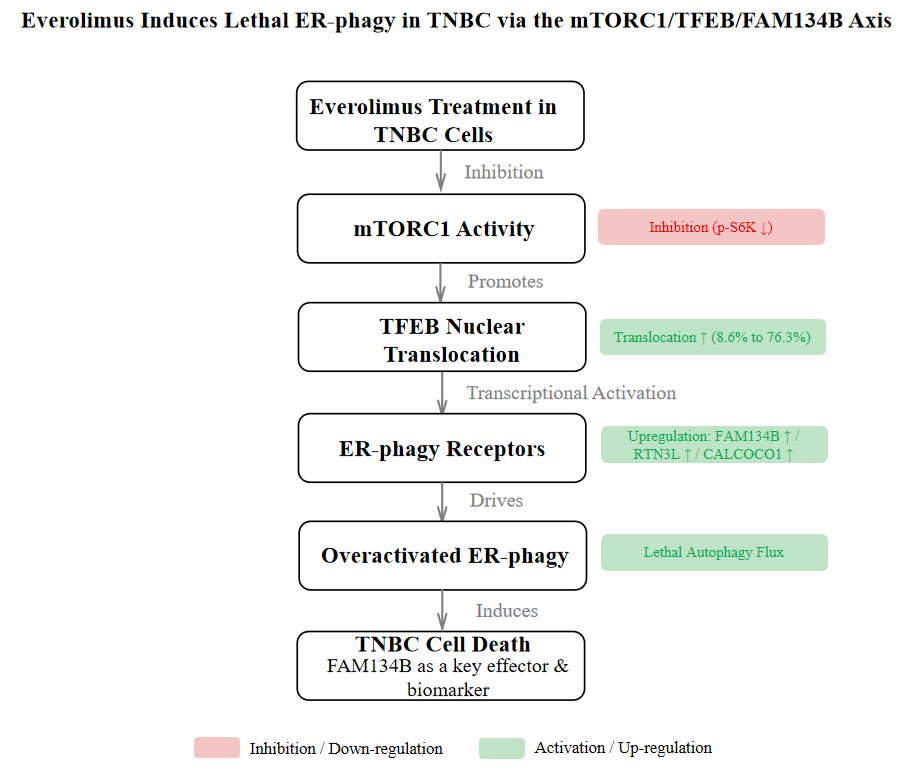
inhibits mTORC1 signaling, promotes TFEB nuclear translocation and activates
ER-phagy in triple-negative breast cancer
Xia Da, Bin Zhang, Jin Lv, Jin Xu
Available Online Date: 24 Nov 2026
Abstract
Abstract: Background: Triple-negative
breast cancer (TNBC) is aggressive with a poor prognosis. Everolimus, an mTORC1
inhibitor, shows limited efficacy as monotherapy in TNBC and the mechanisms
remain unclear. Objectives: This study investigated whether everolimus promotes
TFEB nuclear translocation by inhibiting mTORC1, whether nuclear TFEB
upregulates the ER-phagy receptors FAM134B, RTN3L and CALCOCO1 and whether
FAM134B mediates its anti-TNBC effect. Methods: MDA-MB-231 and MDA-MB-468 cells were used. Viability
and apoptosis were assessed by CCK-8 and flow cytometry. TFEB nuclear
translocation was analyzed by immunofluorescence and nucleocytoplasmic
fractionation. Autophagic flux and ER-phagy receptor expression were examined
by Western blot and BafA1 blockade. ER-phagy flux was verified by
mCherry-GFP-KDEL reporter assay and electron microscopy. ChIP-qPCR validated
TFEB-receptor promoter binding. siRNA knockdown and complementation assays
determined molecular necessity. In vivo effects were confirmed in xenograft models.
Results: Everolimus
inhibited TNBC cell viability in a dose- and time-dependent manner (72 h
inhibition: 77.55%) and induced apoptosis (from 6.2% to 34.7%). Everolimus
inhibited mTORC1 signaling, as shown by reduced phosphorylation of S6K and
4E-BP1 and promoted TFEB nuclear translocation (from 8.6% to 76.3%). Nuclear
TFEB directly bound to CLEAR elements in the promoters of FAM134B, RTN3L and
CALCOCO1, upregulating their expression (FAM134B, 4.32-fold) and driving
ER-phagy flux (autophagic vesicles per cell section: 0.34 to 5.68; mCherry/GFP
ratio: 0.23 to 0.81). TFEB knockdown blocked these effects and reversed
everolimus-induced cytotoxicity. FAM134B knockdown alone reversed
everolimus-induced cell death (viability recovered from 22.45% to 78.92% at 72
h) and ER-phagy, whereas FAM134B re-expression restored sensitivity. In vivo, everolimus reduced tumor volume
by 62.3%, accompanied by enhanced TFEB nuclear translocation, increased FAM134B
expression and LC3-II accumulation. Conclusion: Everolimus inhibits TNBC by suppressing mTORC1-mediated TFEB
phosphorylation, promoting TFEB nuclear translocation and FAM134B upregulation,
ultimately inducing lethal ER-phagy. FAM134B is a major downstream effector and
candidate efficacy biomarker.
Keywords
Everolimus
Endoplasmic reticulum autophagy
FAM134B
mTORC1 signaling pathway
Triple-negative breast cancer
TFEB nuclear translocation