Curcumin carried by polystyrene nanoparticles inhibits phosphatidylinositol 3-kinase/protein kinase B signaling pathway through miR-186 and down-regulates Twist to inhibit the epithelial-mesenchymal transition in colorectal cancer in mice
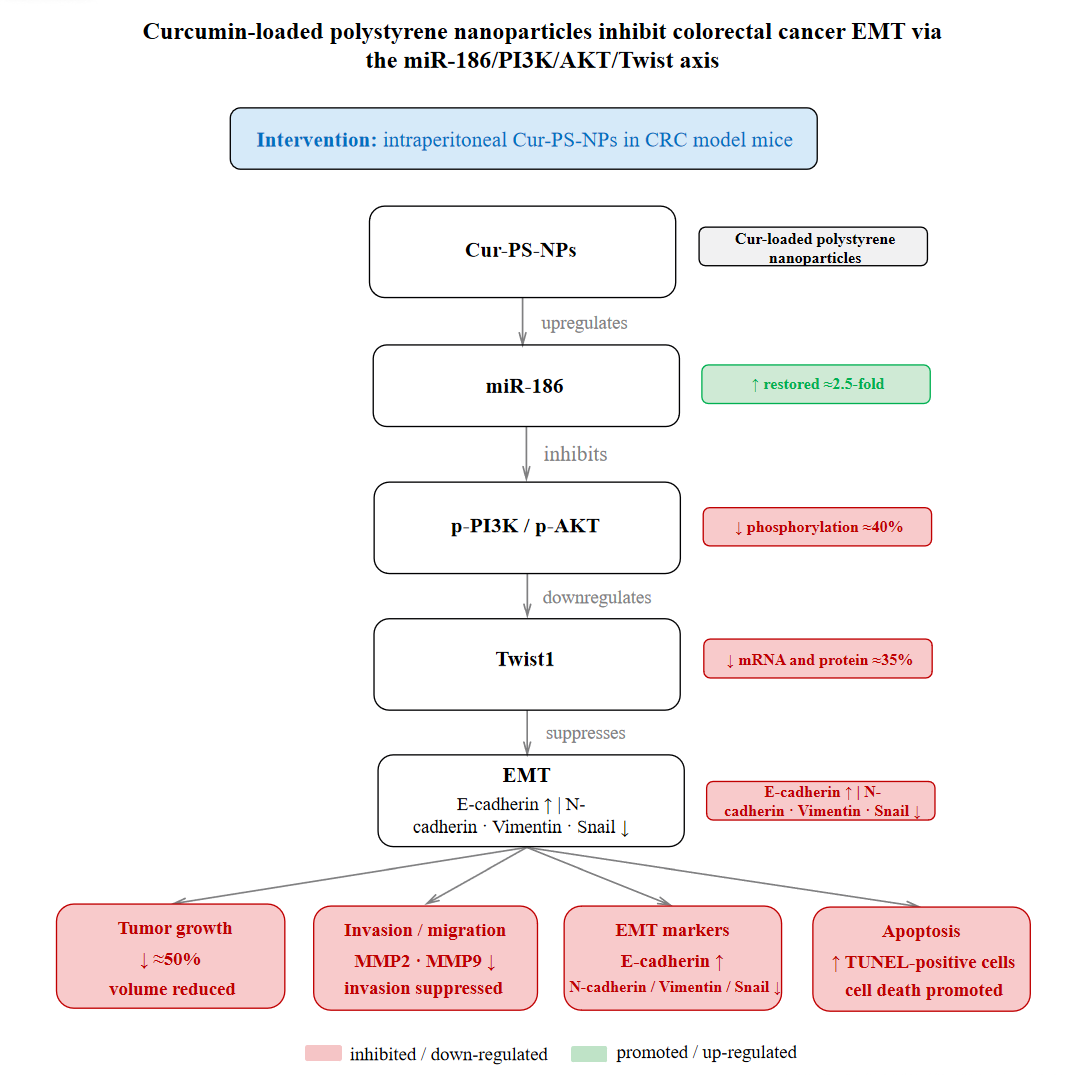
Abstract: Background: Epithelial-mesenchymal transition (EMT) is involved in colorectal cancer (CRC) pathogenesis. Curcumin (CUR) is widely used in the treatment of CRC. Polystyrene nanoparticles (PS-NPS) have a high specific affinity and have an inhibitory effect on cell proliferation. Therefore, the purpose of this study is to investigate the mechanism of inhibition of EMT in colorectal cancer mice by preparing curcumin polystyrene nanoparticles (CUR-PS-NPS). Objective: This study aimed to construct CUR-PS-NPS and investigate their mechanism in inhibiting CRC EMT via the miR-186/PI3K/AKT/Twist axis. Method: CUR-PS-NPS were prepared and characterized. In-vivo, CRC model mice (Balb/c, male) were divided into four groups: sham-operated control (PC), CRC model (CRC), low-dose CUR-PS-NPS (Cur-PS-NPS-L), and high-dose CUR-PS-NPS (Cur-PS-NPS-H). After intraperitoneal injection, tumor volume, EMT marker proteins and changes in miR-186 and the PI3K/AKT/Twist pathway were measured. In-vitro, human normal colonic epithelial cells (NCM460) were used to validate miR-186 interference and SW480 cells were co-transfected with a PI3K inhibitor to clarify the specific mechanism by which CUR-PS-NPS inhibit EMT. Results: In CRC mice intervened with CUR-PS-NPS, the tumor volume was reduced by 50%, the expression of mir-186 was up-regulated by 2.5 times, the phosphorylation level of PI3K/AKT was decreased by 40%, the expression of Twist protein was down-regulated by 35% and the expression of the EMT marker E-cadherin was increased. The expressions of N-cadherin, Vimentin and Snail decreased significantly. Conclusion: CUR-PS-NPS can effectively delay the EMT process of CRC by up-regulating mir-186, inhibiting the PI3K/AKT signaling pathway and the expression of Twist. This discovery provides a new strategy for targeted therapy based on nanocarriers and its application potential in clinical practice can be further explored in the future.